What is Nemesis Downfall (ND) Crypto Coin? Tokenomics, Gameplay & Risks

You’ve probably scrolled past dozens of new crypto tokens promising the next big thing. But what happens when a token is tied to a specific video game rather than a broad platform? That’s exactly where Nemesis Downfall sits. If you are looking at the ticker symbol ND, which stands for the utility and reward token for the Nemesis Downfall play-to-earn first-person shooter, you need to understand that this isn’t just another meme coin or generic governance token. It is deeply integrated into a multiplayer FPS (first-person shooter) ecosystem.
As of mid-2026, ND operates primarily on the Binance Smart Chain (now known as BNB Chain). It serves two main groups: players who earn it by winning matches and buying in-game assets, and node operators who provide infrastructure for the game and receive a cut of the revenue. Before you decide to buy, hold, or invest time in this project, let’s break down exactly how it works, why the data looks so messy, and what risks you are actually taking.
The Core Concept: A Game-First Token
Most crypto projects start with code and add a community later. Nemesis Downfall flips that script. The central entity here is the game itself-a PC-based multiplayer shooter that allows both free-to-play and competitive tournament modes. The ND token is the economic layer that keeps this engine running.
Think of ND like virtual gold in an old-school MMO, but with one major difference: you can withdraw it. When you win a match, you don’t just get points; you get ND tokens. You can use these tokens to buy weapon skins, upgrades, and other cosmetic or functional assets within the game. Alternatively, you can sell them on decentralized exchanges if you want real-world value. This dual utility-internal spending and external trading-is what defines its purpose.
The project aims to expand beyond PC. Roadmaps from early 2026 indicate plans for Android, iOS, and console compatibility. If they pull this off, the user base for ND could grow significantly. Until then, it remains a niche asset for PC gamers comfortable with blockchain wallets.
How the Technology Works: Chains and Bridges
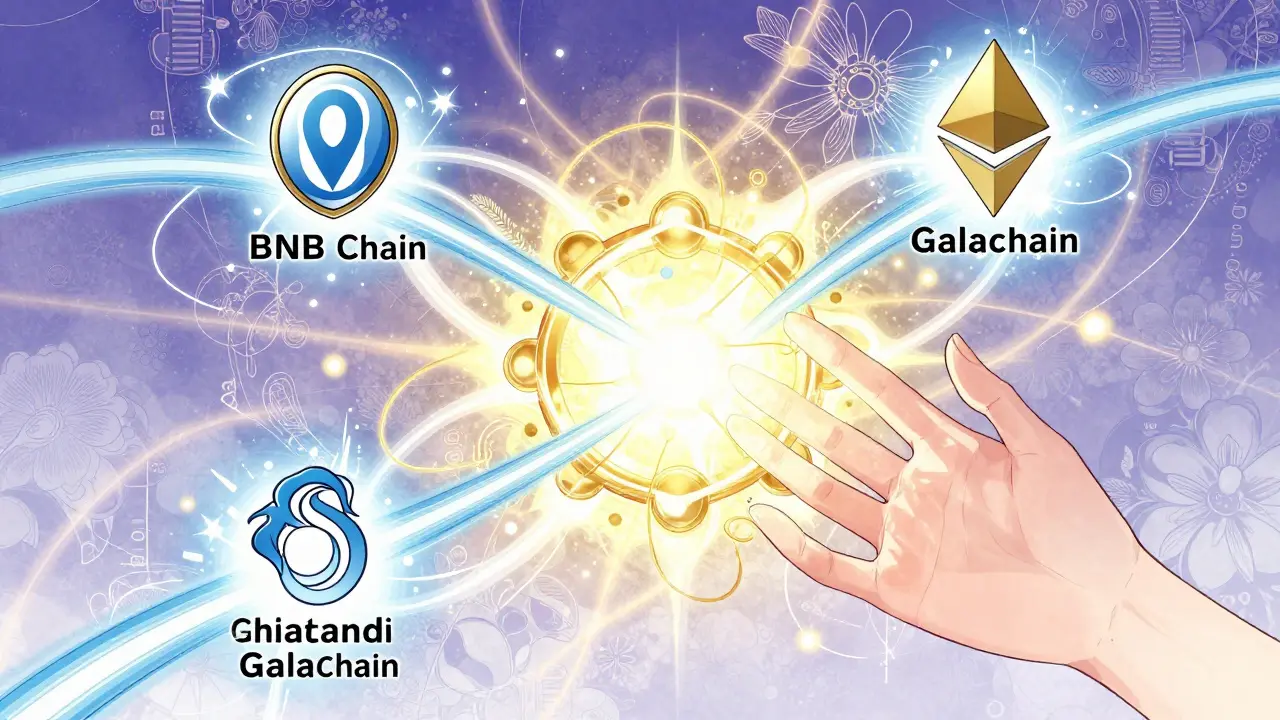
Here is where things get technical, but stick with me because this affects your money. Nemesis Downfall doesn’t live on just one blockchain. It uses a hybrid architecture that spans three different networks:
- BNB Chain: This is where the ND token lives. Most daily transactions, like buying skins or transferring rewards, happen here because fees are low and speeds are fast.
- Ethereum: Node ownership is tracked here. When you buy a node, you get an ERC-1155 NFT on Ethereum. This proves you own the infrastructure rights.
- GalaChain: This is used for claiming certain node rewards. A cross-chain bridge moves ND tokens between BNB Chain and GalaChain to keep costs down while maintaining security.
Why does this matter? Because if you are a player, you mostly interact with BNB Chain. If you are a node operator, you need to manage assets across all three. This complexity is a barrier to entry. You aren’t just clicking "buy" on an app store; you are managing private keys, bridging assets, and watching gas fees on multiple chains.
Tokenomics: Supply, Burns, and Rewards
Let’s look at the numbers. The total supply of ND is capped around 19.85 billion tokens. As of late 2026, roughly 17 billion of those are circulating. That sounds like a lot, but in crypto terms, micro-cap tokens often have high supplies to make the price per unit look small (e.g., fractions of a cent).
The project claims to be deflationary. How? Through a combination of burn mechanisms and buybacks. Here is the breakdown of where the money goes:
| Allocation Category | Amount / Percentage | Purpose |
|---|---|---|
| Total Max Supply | ~19.85 Billion ND | Capped limit of all tokens ever created |
| Node Prize Pool | 850 Million ND (4.25%) | Rewards for node operators over 3 years |
| In-Game Reward Share | 10% of all rewards | Allocated to node owners starting Q4 2025 |
| Buyback Capital | 15% of node sale funds | Used to buy back ND from the market to reduce supply |
The most interesting part for investors is the node structure. Node owners don’t just get static rewards. Starting in late 2025, they began receiving 10% of all in-game rewards generated by players. Plus, 15% of the capital raised from selling nodes is used to buy back ND tokens from the open market. These bought-back tokens are effectively removed from circulation, creating upward pressure on the price-if enough people are playing and earning.
The Node Operator Model: Passive Income or Trap?
If you aren’t a gamer, you might still be interested in ND as a node operator. The project sells up to 10,000 nodes. Each node is an NFT on Ethereum that locks for 180 days after purchase. During this lock-up, you cannot sell it. Afterward, it becomes tradable.
So, what do you get? You host parts of the game’s decentralized network. This includes game hosting, content distribution, and security. In return, you earn ND tokens. BeInCrypto and PlayToEarn guides suggest this is a form of passive income, but there are catches.
- Cost: Nodes were initially priced around 100 USDC for the first tier and 200 USDC for the second. You need upfront capital.
- Lock-up: Your investment is stuck for six months. If the project fails or the token crashes, you can’t exit quickly.
- Technical Skill: You must connect wallets, bridge tokens, and claim rewards manually via GalaChain. This isn’t set-and-forget like a staking pool on a major exchange.
The promise is attractive: a share of the game’s revenue. The reality depends entirely on whether people keep playing Nemesis Downfall. If the player base shrinks, the "10% of in-game rewards" becomes a very small number.
Market Data: Why Prices Look So Weird
If you check the price of ND on different sites, you will see conflicting information. This is normal for micro-cap tokens but confusing for beginners. Let’s clear it up.
On some platforms like CoinGecko, the market cap might show under $1,000. On others like Delta.app, it might show hundreds of thousands of dollars. Why the gap? Liquidity.
ND trades almost exclusively on PancakeSwap v2. There is no centralized exchange listing (like Coinbase or Binance). This means there is only one place to buy and sell. When volume is low-which it often is, sometimes under $500 in 24 hours-the price can swing wildly based on a single large trade.
Also, watch out for data errors. Some aggregators list historical highs that are clearly mistakes (like millions of dollars), likely due to decimal errors in their feeds. Always cross-reference at least three sources. Currently, ND is ranked outside the top 10,000 cryptocurrencies globally. This classifies it as a high-risk, speculative asset.
Risks You Cannot Ignore
I’m not here to tell you not to buy. I’m here to tell you what could go wrong. Here are the specific risks associated with Nemesis Downfall:
- Illiquidity Risk: Because trading is concentrated on one DEX pair (ND/BSC-USD), selling a large amount of ND could crash the price instantly. You might not find a buyer at the price you expect.
- Project Dependency: The value of ND is tied 100% to the success of the Nemesis Downfall game. If the game gets buggy, loses popularity, or fails to launch on mobile, the token has no independent value.
- Complexity Friction: Requiring users to bridge between Ethereum, BNB Chain, and GalaChain creates friction. Many casual gamers will drop out before they even start earning, reducing the reward pool for everyone.
- Lack of Transparency: Major data aggregators do not list specific founders or a legal entity behind the project. While common in early-stage web3, it means there is less accountability if something goes wrong.
Is It Worth It? Who Is This For?
Nemesis Downfall is not for everyone. It is best suited for two types of people:
1. Hardcore FPS Gamers who love Web3: If you already play shooters and want to monetize your skill, ND offers a direct path. You play, you win, you get paid. The risk is lower for you because you are using the product anyway.
2. Technical Node Operators: If you understand blockchain infrastructure, have spare hardware, and want exposure to gaming yields without playing, the node model offers a structured revenue share. But you must be prepared for the 180-day lock-up and the technical hassle of multi-chain management.
For pure financial investors looking for quick gains, ND is extremely risky. The low liquidity and micro-cap status mean you could lose most of your investment if the market turns against it. Treat any money put into ND as venture capital-you expect high returns, but you accept the possibility of total loss.
What is the current price of Nemesis Downfall (ND)?
The price of ND fluctuates significantly due to low liquidity. As of mid-2026, prices range from fractions of a cent (e.g., $0.00000007) to slightly higher depending on the aggregator. Always check live data on PancakeSwap or major trackers like CoinGecko and CoinMarketCap, as discrepancies are common.
Can I play Nemesis Downfall on my phone?
Currently, Nemesis Downfall is a PC-client-based game. However, the development roadmap includes plans for Android, iOS, and console releases. No specific launch dates for these mobile versions have been confirmed as of July 2026.
How do I buy ND tokens?
ND is primarily traded on PancakeSwap v2, a decentralized exchange on the BNB Chain. You will need a compatible wallet (like MetaMask or Trust Wallet), some BNB for gas fees, and you must swap BNB for ND directly on the platform. There is no centralized exchange listing yet.
Are node rewards guaranteed?
Node rewards are structurally defined in the tokenomics (e.g., 10% of in-game rewards), but the actual value depends on player activity. If no one plays the game, the reward pool shrinks. Additionally, node NFTs are locked for 180 days, meaning you cannot sell them during this period regardless of performance.
Is Nemesis Downfall a scam?
There is no evidence suggesting Nemesis Downfall is a fraudulent scheme; it is listed on major data aggregators and has active development. However, it is a high-risk micro-cap investment. The lack of named founders and low liquidity carry significant speculative risks typical of early-stage web3 gaming projects.