What is Artmeta (MART) Crypto? Tokenomics, Price History & Risks Explained

Have you ever wondered how a digital coin could bridge the gap between high-end galleries and blockchain technology? That was the promise of ArtMeta, a platform that aims to merge fine art with decentralized finance using its native cryptocurrency, $MART. But does this project still hold value in today’s volatile crypto market? With prices fluctuating wildly and trading volumes remaining thin, understanding what lies beneath the surface is crucial before you consider buying or holding any tokens.
This guide breaks down exactly what ArtMeta is, how the $MART token functions within its ecosystem, and what the current data says about its viability. We’ll look at the tokenomics, the stark reality of its price history, and the risks involved for anyone looking to get involved.
The Core Concept: Bridging Fine Art and Blockchain
At its heart, ArtMeta is a blockchain-based platform designed to integrate traditional fine art with digital technology. It isn’t just another metaverse game where you buy virtual land. Instead, it positions itself as a full-service design and development hub. The goal is to create an immersive digital universe where artists, galleries, and collectors can interact seamlessly.
The platform connects premier physical galleries with digital collectors. Think of it as a virtual extension of places like Sotheby’s or Christie’s, but built on blockchain infrastructure. By leveraging Non-Fungible Tokens (NFTs), ArtMeta allows users to purchase rare artwork directly from world-class artists. However, it doesn't stop at just digital files. The project claims to establish trusted connections with traditional logistics partners, custody providers, insurance companies, and banks. This integration attempts to solve one of the biggest hurdles in the art world: trust and provenance.
For the average user, the value proposition is access. You get unprecedented entry into the fine art market without needing millions of dollars in liquid cash. For artists, it offers a new revenue stream through digital sales and royalties. The $MART token acts as the fuel for this entire engine, facilitating transactions, governance, and rewards within the ecosystem.
Understanding the $MART Token Utility
So, what do you actually use the $MART token for? It serves as the core utility mechanism for the ArtMeta ecosystem. In most crypto projects, tokens are used for governance or speculation, but ArtMeta intends for $MART to support a perpetual digital economy for artists.
Here is how the token fits into the daily operations:
- Purchasing Art: Users can spend $MART to buy NFT-based artwork or potentially fractional shares of physical pieces displayed on the platform.
- Event Participation: Access to exclusive virtual exhibitions and high-end events often requires holding or spending the token.
- Ecosystem Rewards: Artists and curators may receive $MART as compensation for their contributions to the platform.
Technically, the token operates on an Ethereum-compatible blockchain. This means you don’t need special hardware to hold it. If you have a wallet like MetaMask, you can import the token easily. The contract address is publicly listed as 0xdcff29b7bd211aaef6e4a3989e4d3f732cf5b4b6. Always double-check this address against official sources before sending any funds, as scammers often copy-paste fake addresses.
Tokenomics: Supply, Circulation, and Dilution Risks
When evaluating any cryptocurrency, you must look at its tokenomics-the economic structure behind the asset. For ArtMeta, the numbers tell a story of significant potential dilution.
| Metric | Value | Implication |
|---|---|---|
| Total Maximum Supply | 100 Million | Hard cap on total tokens ever created |
| Circulating Supply | ~3.46 Million | Only ~3.46% of total supply is currently available |
| Fully Diluted Valuation (FDV) | BTC 3.7626 | Theoretical market cap if all 100M tokens were circulating |
| Blockchain Network | Ethereum Compatible | Requires ETH for gas fees; compatible with MetaMask |
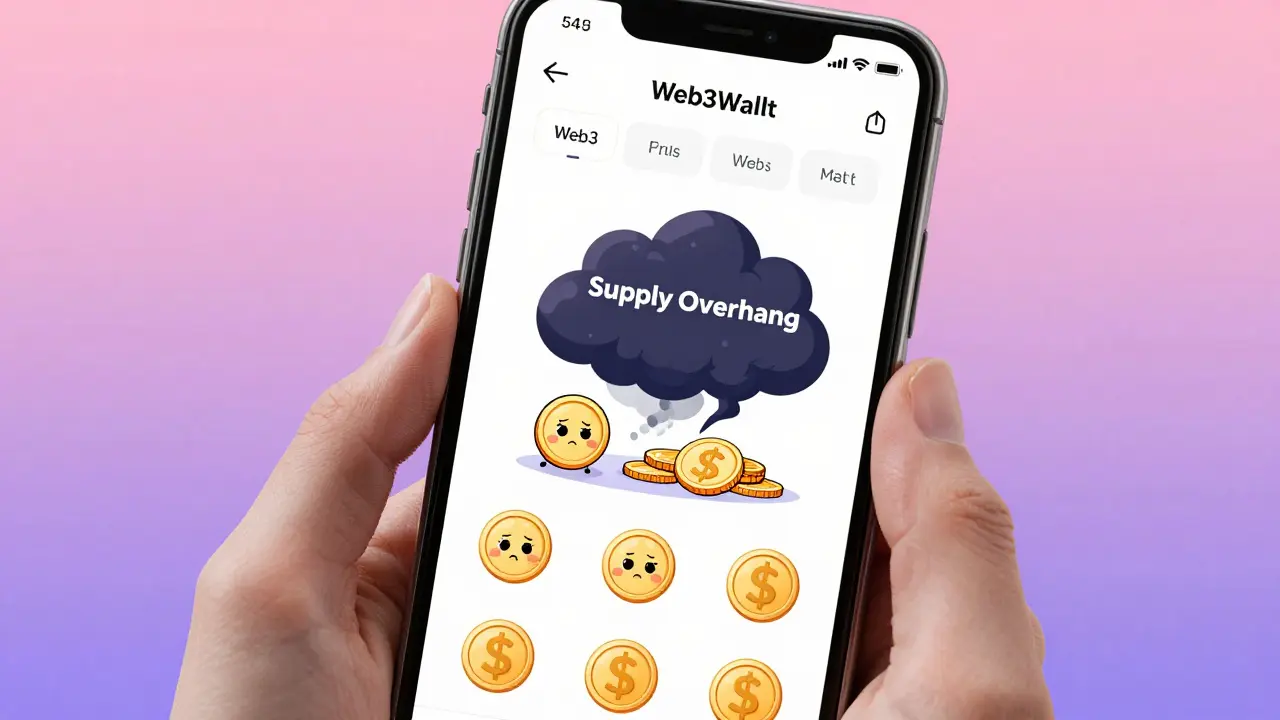
The critical takeaway here is the disparity between the total supply and the circulating supply. With only 3.46 million tokens out of 100 million in circulation, there is a massive amount of inventory yet to be released. In crypto terms, this creates a "supply overhang." If the team decides to unlock more tokens for marketing, team rewards, or liquidity pools, the increased supply could drive the price down unless demand increases proportionally. This is a common risk in early-stage projects, but it is particularly pronounced here.
Price History: From Peak to Trough
Let’s talk about the money. Or rather, the lack of it. If you bought $MART at its peak, you’ve likely seen your investment evaporate. The historical performance of ArtMeta is a classic example of the boom-and-bust cycle that plagues many niche crypto projects.
The all-time high (ATH) for $MART was recorded at approximately $0.3808 on July 14, 2022. At that time, hype around NFTs and metaverse platforms was at its zenith. Fast forward to mid-2026, and the token trades around $0.0025. This represents a decline of roughly 98.8% from its peak. To put that in perspective, if you invested $1,000 at the top, it would now be worth less than $13.
However, the floor hasn't been entirely stable either. The all-time low (ATL) hit $0.001298 on April 7, 2025. Since then, the price has recovered slightly, sitting about 245% above that low. While a 245% gain sounds impressive on paper, remember that it’s a recovery from near-zero. The volatility remains extreme, with daily swings capable of wiping out small accounts quickly.
As of late March 2026, data from aggregators like CoinGecko shows a 24-hour trading volume of roughly $11,595. Other sources like CryptoRank report even lower figures, around $9,750. Low volume is a red flag. It means there aren’t enough buyers and sellers active in the market. If you try to sell a large amount of $MART, you might not find enough buyers at your desired price, leading to significant slippage-where your execution price is much worse than the listed price.
Liquidity and Exchange Availability
Where can you actually trade this thing? This is where things get tricky for retail investors. Unlike Bitcoin or Ethereum, which are listed on major centralized exchanges like Binance or Coinbase Pro, $MART has limited presence.
Data indicates that $MART trades primarily on decentralized exchanges (DEXs) like QuickSwap. On these platforms, you swap tokens directly from your wallet. The primary trading pair is $MART/WETH (Wrapped Ether). The maximum trading volume observed for this pair has been as low as $52 in certain periods, representing nearly 100% of the volume on that specific platform. This extreme illiquidity makes entering and exiting positions difficult and risky.
Sometimes, you might see listings on smaller centralized exchanges or aggregator sites, but the depth is shallow. Always check the order book if possible. If you see a huge gap between the best bid and best ask, stay away. You are essentially gambling on whether someone else wants to take the other side of your trade.
Risks and Due Diligence Checklist
Before you add $MART to your portfolio, run through this checklist. The crypto space is rife with abandoned projects and rug pulls, and ArtMeta exhibits several warning signs that require careful scrutiny.
- Development Activity: Check the project’s GitHub repository. Are developers pushing code regularly? A silent repo for months is a bad sign.
- Team Transparency: Do you know who runs ArtMeta? Are they doxxed (publicly identified)? Anonymous teams carry higher risk.
- Community Engagement: Look at their Discord or Telegram. Are real people discussing features, or is it just bots spamming pump signals?
- Utility vs. Speculation: Is the token actually being used for art purchases, or is it just being traded by speculators hoping for a quick flip?
- Smart Contract Audit: Has the contract been audited by a reputable firm? Unaudited contracts can contain backdoors allowing creators to drain funds.
The dramatic drop from the 2022 peak suggests significant challenges in market adoption. Perhaps the competition from larger NFT marketplaces like OpenSea or specialized art platforms overwhelmed ArtMeta. Or maybe the fundamental value proposition didn't resonate with collectors. Without recent roadmap updates or major announcements, the project appears to be in a dormant or repositioning phase.
Conclusion: Is ArtMeta Worth Your Attention?
ArtMeta represents an ambitious idea: merging the prestige of fine art with the accessibility of blockchain. The concept is sound, and the integration of traditional logistics with digital assets is a necessary evolution for the industry. However, the execution and market reception have struggled significantly.
The $MART token is highly speculative. With 96%+ of its supply yet to circulate, extreme price volatility, and minimal liquidity, it carries substantial risk. It is not suitable for conservative investors or those seeking stable returns. If you are interested in the intersection of art and crypto, consider established players first. If you decide to experiment with $MART, treat it as a high-risk venture capital bet: invest only what you can afford to lose completely, and keep a close eye on development updates.
What is the current price of ArtMeta (MART)?
As of late March 2026, the $MART token trades at approximately $0.0025. However, prices vary across exchanges due to low liquidity, ranging from $0.0017 to $0.0045 depending on the platform and trading pair.
How do I buy ArtMeta (MART) tokens?
You typically need a Web3 wallet like MetaMask. Import the token using the contract address 0xdcff29b7bd211aaef6e4a3989e4d3f732cf5b4b6. Then, connect your wallet to a decentralized exchange like QuickSwap and swap ETH or WETH for $MART. Be cautious of high slippage settings.
Is ArtMeta a scam?
There is no definitive evidence labeling ArtMeta as a outright scam, but it exhibits high-risk characteristics such as extreme price drops, low liquidity, and limited recent development activity. Always perform your own due diligence and verify smart contract audits before investing.
What is the total supply of MART tokens?
The total maximum supply of $MART is 100 million tokens. Currently, only about 3.46 million tokens are in circulation, meaning a large portion of the supply is yet to be released, which poses dilution risks.
Why did the price of MART drop so much?
The price dropped from an all-time high of $0.38 in 2022 to under $0.003 in 2026 due to broader crypto market downturns, loss of investor interest in niche NFT projects, and potentially stagnant development or adoption rates within the ArtMeta platform.