DOOAR (BSC) Exchange Review: Is It Safe or Just Another Low-Liquidity DEX?

Imagine finding a crypto exchange with half a million Twitter followers but absolutely zero website traffic. That is the confusing reality of DOOAR (BSC), a decentralized exchange that launched in 2022 on the Binance Smart Chain. On paper, it looks like a community-driven project with momentum. In practice, the numbers tell a very different story. If you are looking for a place to trade your tokens without getting wrecked by slippage or hidden risks, this review cuts through the noise to show you exactly what is happening under the hood.
We are going to look at the actual trading pairs, the terrifyingly thin liquidity, and why a platform with such high social media engagement has vanished from the radar of serious traders. By the end of this, you will know whether DOOAR is a hidden gem or a trap you should avoid entirely.
The Reality Check: Volume vs. Hype
Let's start with the most glaring contradiction. DOOAR claims a massive presence on social media, boasting over 594,000 followers on X (formerly Twitter). Usually, that kind of following translates into active users and healthy trading volume. But here? The data says otherwise.
As of mid-2026, the exchange reports a 24-hour trading volume of just $20,257.82. To put that in perspective, major decentralized exchanges like PancakeSwap or Uniswap process billions in daily volume. Even smaller niche DEXs often clear millions. A drop of 12% in the last day might not seem huge, but when your total pool is so small, every single trade moves the needle significantly.
More concerning is the web traffic. Recent monthly pageviews are reported at zero. The Alexa ranking sits at #1,935,804 globally. This means almost no one is visiting the site to trade. So, who are those 594,000 Twitter followers talking to? Are they bots? Are they holders of a token that is illiquid and stuck? Or is the community dormant? Without active web traffic, the social media numbers feel like a hollow metric designed to create an illusion of legitimacy.
Trading Pairs: What Can You Actually Trade?
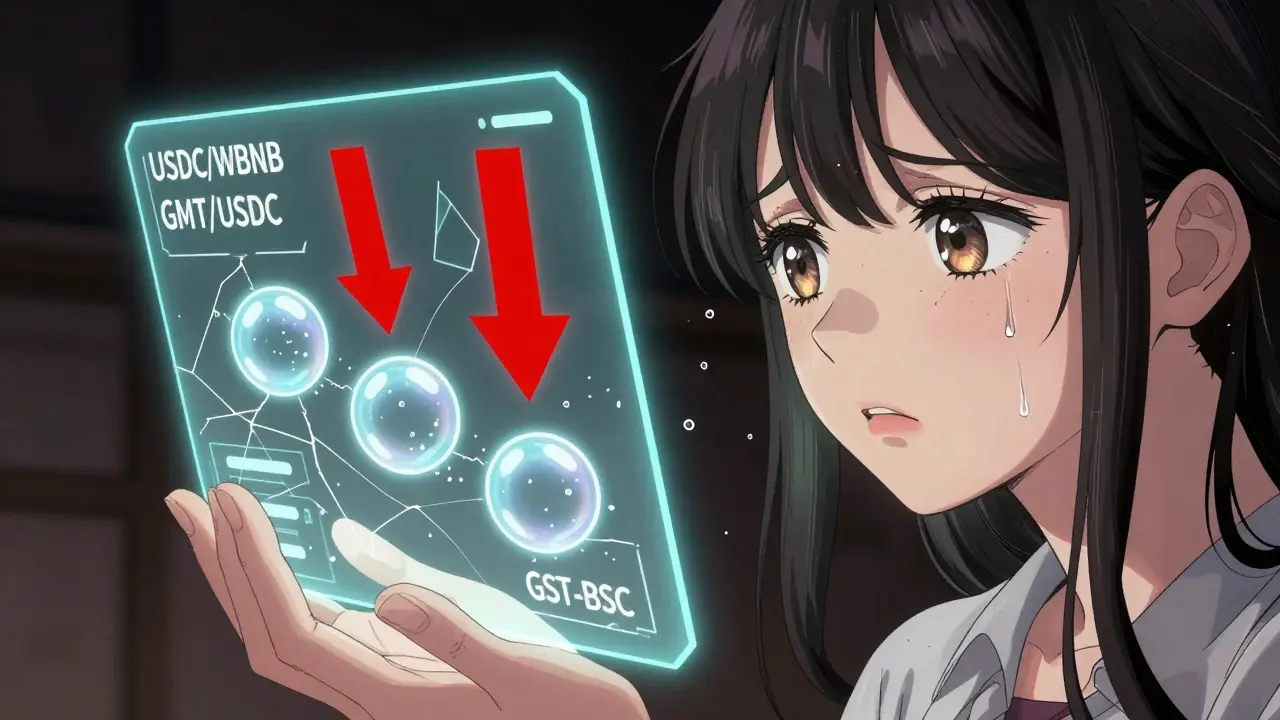
If you log in expecting a wide variety of assets, you will be disappointed. DOOAR currently lists only three coins and three trading pairs. This extreme limitation suggests the platform is either in maintenance mode, struggling to attract new listings, or focused solely on a specific micro-niche.
| Trading Pair | 24h Volume | Market Share | Bid-Ask Spread | Price Impact Risk |
|---|---|---|---|---|
| USDC / WBNB | $13,287.72 | 65.57% | 0.60% | Moderate |
| GMT / USDC | $5,549.00 | 27.38% | 0.61% | High |
| GST-BSC / USDC | $1,429.00 | 7.06% | 0.61% | Very High |
The USDC/WBNB pair dominates the activity, accounting for nearly two-thirds of all volume. USDC is a stablecoin pegged to the US Dollar, and WBNB is the wrapped version of BNB, the native token of the Binance Smart Chain. While this is a standard pair, the volume is too low to support any meaningful institutional or even serious retail trading.
The other two pairs involve GMT (Green Metaverse Token) and GST-BSC (Green Satoshi Token), both associated with the STEPN fitness app ecosystem. These are volatile, utility-specific tokens. Trading them against USDC on a platform with less than $2,000 in daily volume for the GST pair is risky. You are essentially trying to move weight in a featherweight division.
Liquidity Depth: The Silent Killer
In decentralized finance, liquidity is king. It determines how easily you can buy or sell without crashing the price. Let's look at the order book depth for DOOAR. This metric shows how much money is available within a 2% price range above and below the current market price.
- USDC/WBNB: +2% depth is $14,226; -2% depth is $14,183.
- GMT/USDC: +2% depth is $3,312; -2% depth is $3,302.
- GST-BSC/USDC: +2% depth is $1,274; -2% depth is $1,270.
What does this mean for you? If you try to buy $10,000 worth of WBNB using USDC, you will likely slip more than 2% because there isn't enough liquidity sitting in the order book to absorb your trade at the current price. You will eat up the entire depth and push the price up against yourself. For the GST pair, a trade of just $1,000 could cause significant slippage.
This makes DOOAR unsuitable for anyone moving more than a few hundred dollars. It is a playground for micro-traders, but even then, the spreads are punishing. The average bid-ask spread across these pairs is 0.606%. While competitive for some DEXs, combined with the low depth, it means you start every trade at a disadvantage. You need the price to move more than 0.6% just to break even before fees.
Under the Hood: Binance Smart Chain Infrastructure
DOOAR operates on the BNB Smart Chain (formerly Binance Smart Chain). This is a crucial detail because it dictates the speed and cost of your transactions. BSC uses a Proof of Staked Authority (PoSA) consensus mechanism, which allows for block times of approximately 3 seconds.
Compared to Ethereum, where transaction fees (gas) can spike to $10 or more during busy periods, BSC keeps costs under $0.10 per transaction. This is a massive advantage for small trades. However, DOOAR does not offer margin trading, nor does it have tiered fee structures based on volume. You pay the same flat rate regardless of how much you trade.
The platform supports BEP-20 tokens, which are compatible with Ethereum’s ERC-20 standard. This means if you have a wallet like MetaMask or Trust Wallet, connecting to DOOAR is straightforward. But remember: compatibility doesn't equal security. Just because the code runs on a robust network like BSC doesn't mean the smart contracts governing DOOAR itself are safe.
Security and Transparency: The Missing Pieces
Here is where the review gets uncomfortable. There is a complete absence of verifiable security information for DOOAR. No public smart contract audits from reputable firms like CertiK or Hacken. No insurance fund details. No clear governance structure. No roadmap updates.
In the world of DeFi, "code is law," but bad code can still steal your money. Without an audit, you have no guarantee that the contract doesn't contain backdoors allowing developers to rug pull (withdraw all liquidity and disappear). Given the lack of recent news coverage, analyst reports, or third-party validation, the risk profile is extremely high.
The team behind DOOAR remains anonymous or unverified. There are no KYC (Know Your Customer) requirements listed, which sounds appealing for privacy but removes accountability. If something goes wrong, there is no customer support hotline, no legal entity to sue, and no recourse for users. You are trusting strangers with your keys.
Is DOOAR Worth Your Time?
Let's be direct. For 99% of traders, DOOAR is not a viable option. The combination of negligible liquidity, limited trading pairs, and zero transparency creates a perfect storm for losses. You might find yourself unable to exit a position because there is simply no one on the other side of the trade willing to buy your tokens at a fair price.
Who might use it? Perhaps someone holding a tiny amount of GMT or GST who wants to swap it quickly without paying higher fees on larger aggregators, and who understands the risk of slippage. But even then, tools like 1inch or PancakeSwap Router often provide better rates by splitting orders across multiple pools.
The disconnect between the 594k Twitter followers and the dead website traffic is a red flag. It suggests potential manipulation of social metrics to appear larger than the project actually is. In crypto, hype without substance is usually a precursor to a crash.
Better Alternatives on BSC
If you want to trade on Binance Smart Chain, stick to the giants. They offer deeper liquidity, regular audits, and proven track records.
- PancakeSwap: The largest DEX on BSC. Massive liquidity, yield farming options, and a strong community.
- BiSwap: Offers lower fees and good liquidity for newer tokens.
- ApeSwap: Strong focus on NFTs and farming, with solid security practices.
These platforms may have slightly higher competition for liquidity, but they ensure you can enter and exit positions efficiently. Don't let the allure of a "hidden gem" DEX trick you into losing capital on a platform that barely exists.
Is DOOAR (BSC) a scam?
While there is no definitive proof of malicious intent, the lack of audits, transparent team information, and extremely low liquidity raises significant red flags. It exhibits many characteristics of high-risk or abandoned projects. Proceed with extreme caution.
Why does DOOAR have so few trading pairs?
The limited selection of only three pairs suggests low user adoption and insufficient capital to support additional liquidity pools. Adding new pairs requires substantial funds to prevent immediate price manipulation, which DOOAR likely lacks.
Can I make large trades on DOOAR?
Absolutely not. With a maximum depth of around $14,000 for its best pair, any trade over $1,000-$2,000 will result in severe slippage, meaning you will get a much worse price than expected. Stick to micro-trades if you must use it.
How do I connect my wallet to DOOAR?
Since it is on BSC, you can use MetaMask or Trust Wallet. Ensure your network is set to BNB Smart Chain (BEP-20). Visit the official DOOAR website, click 'Connect Wallet,' and approve the connection. Always verify the URL to avoid phishing sites.
What is the gas fee for trading on DOOAR?
Gas fees on BSC are typically under $0.10 per transaction. However, DOOAR also charges a trading fee (spread), which averages 0.606%. This spread is effectively a hidden cost added to every buy or sell order.
Why is the website traffic zero despite high Twitter followers?
This discrepancy often indicates inactive or bot-generated social media accounts. Real trading communities drive consistent web traffic. Zero pageviews suggest the project is dormant or the social metrics are artificially inflated to mislead investors.
15 Comments
Write a comment





Daniel J. Cox
June 29, 2026 AT 16:00Man, seeing zero traffic on a site with half a million followers is wild. It really feels like the whole crypto space is just one big echo chamber sometimes. I just keep my bags in PancakeSwap because at least I know someone else is actually there to buy what I sell. :D
Emma Rémond
June 30, 2026 AT 19:38The fundamental analysis presented here is rudimentary at best, yet it highlights a glaring inefficiency in market liquidity provision. The bid-ask spreads of 0.6% are exorbitant for any serious arbitrageur or institutional player. One must question the utility of such a platform when superior alternatives exist with deeper order books and verifiable smart contract audits. It is frankly embarrassing that retail investors still fall for social media metrics devoid of on-chain validation.
Scott Miller
July 1, 2026 AT 19:30Listen up folks! You need to stop being so scared of new platforms! Yes, the volume is low right now, but that means you can get in early before everyone else catches on! If you don't take risks, you don't get rewards! Stop listening to these haters who want to keep you poor! Buy the dip on GMT/USDC and watch it soar! Don't let fear control your portfolio!
Rob Morton
July 2, 2026 AT 20:23I find myself pondering the nature of value in decentralized systems. Is liquidity merely a function of trust, or is it a mathematical certainty? When we look at DOOAR, we see a disconnect between perception and reality. Perhaps this serves as a lesson in epistemology for traders; we must verify our sources rather than accepting the narrative provided by social media influencers. What do you think drives people to trade on such thin pools?
Routh Middaugh
July 3, 2026 AT 16:23It is quite interesting, isn't it? How a project can have so many followers yet no actual users. I suppose, we should all be careful, though. There might be some hidden gems out there, but usually, they are just traps. We need more transparency, definitely. And better security measures, obviously. It makes me nervous, honestly.
Ryan Peters
July 4, 2026 AT 10:24This is exactly why American innovation is being stifled by these unregulated offshore scams. While we build real infrastructure, these guys are playing dress-up with tokens. The lack of KYC is a national security risk waiting to happen. Get off these sketchy DEXs and stick to regulated exchanges if you want to support the rule of law. Sad state of affairs.
ross harris
July 4, 2026 AT 22:16The digital abyss stares back into your wallet when you connect to DOOAR. It's not just an exchange; it's a psychological trap designed to harvest your greed and spit out dust. The liquidity is a mirage, a shimmering illusion in the desert of blockchain garbage. You think you're trading, but you're just feeding the beast. Beware the hollow men.
Carl Belgrave
July 6, 2026 AT 08:30I tell you what, this is absolute garbage. Real traders don't waste their time on sites with $20k volume. That's pocket change. If you can't handle the slippage on a major exchange, you don't deserve to be in this game. Stay away from this trash and protect your capital like a true patriot would.
Carl Hanzel
July 7, 2026 AT 13:37You all are missing the point entirely. Of course the traffic is low. It's exclusive. Only the degens who understand the meta are using it. The fact that it has no audits proves it's not controlled by corporate suits. It's pure chaos. And chaos is where the alpha lives. Keep crying about safety while I make moves.
ELNORA JEFFERSON
July 7, 2026 AT 21:41Ugh. Another review telling us what we already know. It's obvious it's bad. Why do people even bother writing these long articles? Just say 'it's a scam' and move on. I'm tired of reading all this fluff about liquidity depth. My eyes hurt. Can we just agree it's useless and go home?
Carol @minaszilda
July 9, 2026 AT 10:43Let's focus on learning instead of judging. Every platform teaches us something. Even if DOOAR isn't safe, understanding why helps us become better investors. Be kind to yourselves and choose safer paths like PancakeSwap. You deserve peace of mind.
John Curry
July 10, 2026 AT 03:25The silence of the website is deafening. Imagine standing in a grand theater, expecting a roaring crowd, only to find empty seats stretching into infinity. The social media noise is a phantom limb, felt but not present. It is a tragedy of modern finance, where appearance outweighs substance. A haunting reminder of the ephemeral nature of hype.
Trent Erman1
July 12, 2026 AT 00:46Hey team! Let's break this down simply. Low liquidity = high risk. No audits = unknown risk. Zero traffic = dead project. It's that easy! Stick to the big boys like Uniswap or PancakeSwap. They have the depth you need. Don't let FOMO drive you into a ditch! Stay safe and happy trading! 🚀📉
Fiona Ellis
July 12, 2026 AT 23:17I must admit, I was tempted by the low gas fees initially. However, upon closer inspection of the order book depth, it became abundantly clear that the spread costs far outweigh the savings on transaction fees. It is a classic case of penny-wise and pound-foolish. One should always prioritize capital preservation over minor cost efficiencies. 🧐💸
Nicole Woessner
July 13, 2026 AT 16:55its pretty sad really how many bots follow these projects. i used to trade stepn tokens on bigger dexes and never had issues. why risk it here for nothing. just stay away folks. simple as that.