What is Everest (ID) Crypto Coin? Identity, Wallet, and Blockchain Explained

Everest ID Verification Simulator
Simulate the verification process for different scenarios. Everest ID uses a multi-layered approach where each step requires a different type of proof, starting from basic authentication to biometric verification.
Select your scenario to see how verification would work with different devices.
Verification Result
Everest (ID) isn’t just another crypto coin. It’s a system built around something most people don’t even think about until they need it: identity. If you’ve ever struggled to prove who you are online - whether it’s opening a bank account, applying for a loan, or accessing government services - Everest (ID) was designed to fix that. It’s not about speculation. It’s about giving people control over their own digital lives, no matter where they live or what device they have.
What Exactly Is Everest (ID)?
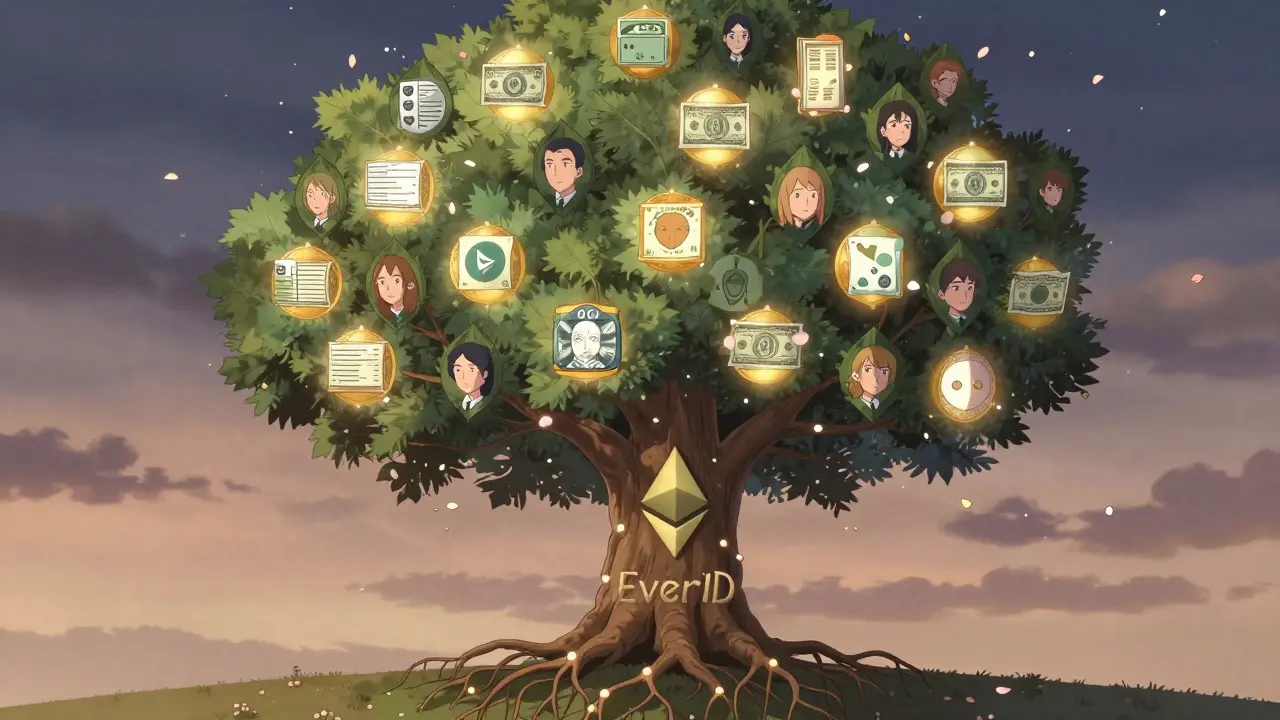
Everest (ID) is the native token of the Everest platform, a decentralized system launched in 2019 that combines digital identity, a multi-currency wallet, and a blockchain transaction network. Unlike most crypto projects that focus on payments or DeFi, Everest (ID) starts with one question: How do you prove you’re you, without a passport, phone, or bank account?
The token itself, called Everest (ID), runs on the Ethereum blockchain as an ERC-20 token. Its contract address is 0xebd9d99a3982d547c5bb4db7e3b1f9f14b67eb83. But the token is just the key - the real value is in the three parts it unlocks: EverID, EverWallet, and EverChain.
EverID: Your Digital Identity, Locked by You
EverID is the heart of the platform. It’s a biometric identity system that stores your personal data - name, birth details, fingerprints, facial recognition - in a secure, encrypted format on the InterPlanetary File System (IPFS). This data isn’t stored on a central server. It’s spread across decentralized supernodes, and only you can unlock it.
Here’s how it works: your identity is split into layers, like a Russian nesting doll. The first layer is protected by a password or PIN. Unlock that, and you get access to the next layer - maybe a fingerprint scan. Unlock that, and you get to your birth certificate. Unlock that, and you can access your financial records. Each step needs a different kind of proof, and no one else can access it without your permission.
This structure is called an “EverID Datagram.” It’s designed so that even if someone steals your device or hacks a website, they can’t get to your core identity. You don’t need a smartphone to use it. You can access EverID through basic internet kiosks, community centers, or even government offices. That’s intentional. The platform was built for people in rural areas, refugee camps, or places where smartphones are rare but identity verification is critical.
EverWallet: More Than Just a Crypto Wallet
EverWallet isn’t just a place to store Everest (ID) tokens. It’s a multi-currency wallet that holds fiat, crypto, and even digital documents like birth certificates, medical records, or property deeds. Everything is encrypted and tied directly to your EverID.
Imagine you’re a farmer in Nepal. You’ve never had a bank account. But with EverWallet, you can receive aid payments in crypto, convert them to local currency, and store your land title digitally - all in one place. No paperwork. No middlemen. No need to travel to a city to prove ownership.
The wallet also lets you send money directly to others on the Everest network. Because every user is verified through EverID, there’s no risk of sending funds to a fake account. It’s like sending cash, but with built-in identity checks.

EverChain: The Transaction Backbone
EverChain is the blockchain that records every transaction made on the Everest platform. It’s not a public chain like Bitcoin or Ethereum. It’s a private, permissioned ledger that only validates transactions between verified users. This means faster confirmations and lower fees - but only if you’ve passed the EverID verification steps.
Third parties - like NGOs, governments, or lenders - can request access to specific parts of your identity to verify eligibility for services. For example, a charity might ask: “Is this person over 18 and registered in this region?” EverChain lets them get a yes/no answer without seeing your full identity. That’s called zero-knowledge proof. It protects your privacy while still enabling trust.
Market Data: Where Everest (ID) Stands Today
As of late 2025, Everest (ID) has a total supply of 800 million tokens, with about 116.7 million in circulation. Its all-time high was $2.04 in 2021. Today, it trades around $0.01 - down over 99% from its peak.
Trading volume is extremely low. Some exchanges show $200 in daily volume. Others show $0. That’s not unusual for niche identity tokens. It’s not a speculative asset. It’s a utility token - meant to be used, not traded.
It’s listed on decentralized exchanges like SushiSwap, but liquidity is nearly nonexistent. That means if you buy it, you might struggle to sell it later. Don’t treat it like Bitcoin or Ethereum. This isn’t a get-rich-quick play. It’s a long-term infrastructure project.
Who’s Using Everest (ID)?
There aren’t any public case studies. No big brands or governments have announced partnerships. That’s the biggest gap in the project. Without real-world adoption, it’s hard to know if the tech actually works at scale.
But the potential use cases are clear:
- Refugees needing to prove identity without documents
- Unbanked populations accessing microloans
- Children in developing countries getting access to education records from birth
- Seniors without smartphones managing pensions
Compare it to Civic (CVC) or SelfKey (KEY) - both are identity-focused crypto projects with bigger communities and more trading volume. But neither has Everest’s “no mobile device required” design. That’s its unique edge.
Is Everest (ID) a Scam?
No, not based on the technology. The code is open. The contract address is public. The architecture is well-documented. There’s no evidence of a rug pull or fake team.
But here’s the catch: the project seems stalled. There haven’t been major updates since 2022. The website is static. Social media is quiet. The team hasn’t posted in over a year. That’s not a red flag - it’s a warning.
If you’re thinking of investing, ask yourself: Are you betting on the tech? Or on the team coming back? Right now, it’s the former. The tech is solid. But without active development, adoption won’t happen.
How to Get Everest (ID)
You can’t buy it on Coinbase or Binance. You need to go to a decentralized exchange like SushiSwap. Connect your wallet (MetaMask, Trust Wallet), swap ETH or USDT for Everest (ID), and store it in a wallet that supports ERC-20 tokens.
But here’s the truth: unless you’re planning to use EverID or EverWallet, there’s no reason to hold it. The token only has value if the platform grows. And right now, it’s not growing.
What’s Next for Everest (ID)?
The platform’s vision - a digital identity system usable by every human from birth to death - is powerful. It’s the kind of idea that could change how the world handles identity.
But vision alone doesn’t build adoption. What Everest needs now is:
- A partnership with a humanitarian organization
- A pilot program with a developing country’s government
- Clear documentation on how to integrate EverID into existing services
Without those, Everest (ID) will remain a footnote in crypto history - a smart idea that never found its users.
Is Everest (ID) a stablecoin?
Some sources claim Everest is a stablecoin, but that’s misleading. It’s not pegged to any asset like USD or gold. The token’s value fluctuates like other cryptos. The confusion comes from Chainlink Ecosystem calling it a “programmable asset-backed stablecoin provider,” but no official documentation or whitepaper confirms this. Everest (ID) is better understood as an identity utility token, not a stablecoin.
Can I use Everest (ID) to pay for things online?
Not yet. There are no major merchants or platforms that accept Everest (ID) as payment. The token is designed to be used within the Everest ecosystem - primarily for accessing EverID and EverWallet features. Outside of that, it has no real-world spending power.
Do I need a smartphone to use Everest (ID)?
No. That’s one of its biggest strengths. The EverID system is designed to work with basic internet access - think public kiosks, tablets in community centers, or even landline-based verification systems. This makes it uniquely suited for areas with low smartphone penetration, like rural Africa or parts of Southeast Asia.
Is Everest (ID) safe to hold long-term?
Only if you believe in the project’s future. The technology is secure and well-designed, but the team has been inactive for over a year. There’s no roadmap, no updates, and no community growth. Holding it is a bet on revival, not a sound investment. Treat it like a prototype - interesting, but risky.
How does Everest (ID) compare to Bitcoin or Ethereum?
It doesn’t. Bitcoin is digital gold. Ethereum is a programmable blockchain. Everest (ID) is a digital identity tool. They serve completely different purposes. Comparing them is like comparing a hammer to a car. Everest doesn’t aim to replace other cryptos - it aims to solve a problem they don’t touch: identity.
14 Comments
Write a comment





Elizabeth Miranda
December 4, 2025 AT 12:58Everest (ID) is one of those projects that makes you pause and think - not about price charts, but about what identity even means in a digital world. Imagine a refugee who’s lost everything but still needs to prove they’re human. This isn’t crypto fantasy. It’s infrastructure for people no one else is building for.
Chloe Hayslett
December 6, 2025 AT 11:47Oh great, another ‘identity token’ that’ll never work because Americans won’t use it and nobody else has the bandwidth to care. We’re drowning in crypto vaporware and this is just the latest glittery coffin.
Jerry Perisho
December 7, 2025 AT 00:21The zero-knowledge proof implementation here is actually elegant. Most identity projects leak metadata. Everest’s layered datagram approach with IPFS storage is rare. It’s not perfect but it’s one of the few that doesn’t assume everyone has a smartphone or a credit score.
Nelson Issangya
December 7, 2025 AT 10:21People keep saying this is dead but you know what’s dead? The idea that identity should be controlled by banks and governments. This tech is alive in the places no one’s watching - and that’s where change starts.
Uzoma Jenfrancis
December 7, 2025 AT 12:47Why should Nigeria or India care about a token built by Americans? We have our own problems. This feels like digital colonialism wrapped in blockchain jargon.
Manish Yadav
December 8, 2025 AT 16:45So you’re telling me I should hold this coin because some poor farmer in Nepal might use it someday? That’s not investing that’s charity with a blockchain sticker.
Krista Hewes
December 10, 2025 AT 10:34wait so you can use this without a phone?? that actually sounds kinda wild… i thought all crypto needed a phone now. kinda cool tbh
Mairead Stiùbhart
December 10, 2025 AT 22:24Oh sweet, another ‘revolutionary’ project that’s been dead since 2022. Congrats, you’ve built a digital tombstone and called it a wallet.
Tara Marshall
December 11, 2025 AT 00:51The real value isn’t the token. It’s the architecture. If you strip away the hype, this is one of the few crypto projects that actually solves a problem that’s been ignored for decades. It’s not sexy. It’s necessary.
Doreen Ochodo
December 12, 2025 AT 22:35This is the future. No phone. No bank. Just you and your identity. Stop looking at the price and start thinking about the people it could help.
Renelle Wilson
December 13, 2025 AT 19:28I’ve spent years working with refugee communities in Jordan and Kenya, and I can tell you this isn’t theoretical. The moment someone can prove they’re a parent, a student, a survivor - without a birth certificate or a passport - that’s when systems begin to heal. Everest’s layered authentication isn’t just technical; it’s deeply human. The fact that it works on basic kiosks means it’s not built for Silicon Valley. It’s built for the margins. And that’s why it matters. The token’s price is irrelevant. What matters is whether someone in a camp in Chad can access food aid because their identity is verified. That’s not crypto. That’s dignity.
ronald dayrit
December 14, 2025 AT 06:48Identity is the last frontier of capitalism. We’ve commodified attention, labor, even emotions - but our very selves? We still let governments and corporations gatekeep that. Everest (ID) doesn’t just offer a tool - it challenges the metaphysical contract of modern society. If your identity is yours, then power shifts. If power shifts, systems collapse. And if systems collapse, what rises? A new kind of person. Not a citizen. Not a consumer. A sovereign being. This project, even stalled, whispers a question we’re too afraid to ask: Who owns you?
Adam Bosworth
December 15, 2025 AT 13:24bro this coin is a ghost. 0 volume. no devs. no updates. someone posted this like it’s a hidden gem but it’s just a graveyard with a .eth domain. if you bought this you’re either a saint or a sucker.
Jonathan Sundqvist
December 17, 2025 AT 05:30Yeah and the team hasn’t said a word since 2022. This isn’t a ‘long-term infrastructure project’ - it’s a dead project with a fancy whitepaper. Don’t romanticize neglect.