What is Cryptocurrency Mining: A Practical Guide for Beginners

Ever wondered how Bitcoin actually works without a bank? The answer lies in cryptocurrency mining. It’s the engine that keeps the network running, securing every transaction and releasing new coins into circulation. But it’s not just about solving math problems; it’s a high-stakes race involving specialized hardware, massive energy consumption, and complex economic incentives. If you’ve ever looked at a mining rig and thought, "How does this actually make money?" you’re in the right place. We’ll break down exactly how the process works, what you need to start, and whether it’s still worth your time in 2026.
The Core Mechanism: Proof of Work Explained
To understand mining, you first have to grasp the concept of Proof of Work (PoW). This is the consensus mechanism used by networks like Bitcoin. Unlike traditional banks that use a central ledger to verify transactions, PoW relies on distributed computational power. Miners compete to solve a cryptographic puzzle. The first one to find the correct solution gets to add a new block of transactions to the blockchain and earns a reward in newly minted coins plus transaction fees.
This process serves two critical purposes. First, it validates transactions, ensuring no one spends the same digital coin twice (a problem known as double-spending). Second, it secures the network. Because solving the puzzle requires significant energy and hardware investment, attacking the network would cost more than you’d likely gain from cheating. This creates an economic barrier that protects the integrity of the currency.
How the Mining Process Actually Works
The technical side of mining might sound intimidating, but the logic is straightforward. Here is the step-by-step flow of a single mining cycle:
- Transaction Collection: When users send cryptocurrency, those transactions enter a temporary holding area called the mempool. Miners pick these up, usually prioritizing transactions with higher fees to maximize their profit per block.
- Block Construction: The miner groups these transactions into a candidate block. This block contains a header with specific data points: the hash of the previous block (linking it to the chain), a timestamp, and a Merkle root (a summary of all transactions in the block).
- Puzzle Solving: The miner’s hardware runs a hashing algorithm, typically SHA-256 for Bitcoin. It generates millions of random numbers (nonces) per second, trying to find a hash value that meets a specific difficulty target set by the network.
- Validation and Reward: Once a miner finds a valid hash, they broadcast the new block to the network. Other nodes verify the work. If valid, the block is added to the blockchain, and the miner receives their block reward.
This cycle repeats approximately every ten minutes for Bitcoin. The speed isn’t arbitrary; it’s a design choice to balance security and finality. Too fast, and the network becomes vulnerable to forks; too slow, and users wait too long for confirmation.
Hardware Wars: ASICs vs. GPUs
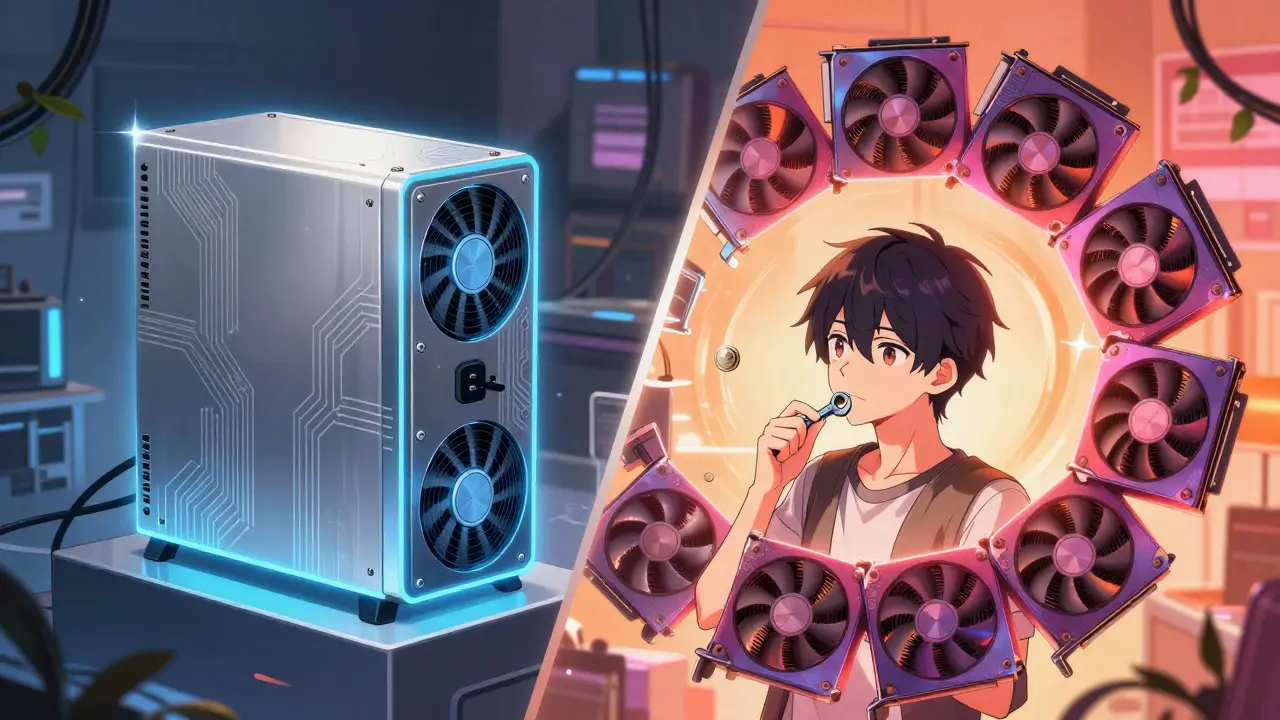
You can’t mine efficiently with your laptop anymore. The industry has shifted toward specialized hardware. There are two main types of mining equipment you’ll encounter:
- ASIC Miners: Application-Specific Integrated Circuits are chips designed solely for one task-usually Bitcoin mining. They offer incredible efficiency and hash rates, far outperforming general-purpose computers. However, they lack flexibility. If Bitcoin’s price drops or the network switches algorithms, your ASIC becomes paperweight.
- GPU Miners: Graphics Processing Units, originally built for gaming and video editing, are versatile. They can switch between different cryptocurrencies (altcoins) by changing software settings. While less efficient than ASICs for Bitcoin, they remain popular for mining other PoW coins like Ethereum Classic or Ravencoin.
Choosing between them depends on your strategy. If you want maximum output for a single coin, go ASIC. If you want flexibility to pivot based on market trends, GPU rigs are your best bet. Keep in mind that both require substantial cooling solutions, as heat management is critical to preventing hardware failure.
Solo Mining vs. Joining a Pool
Once you have your hardware, you face a strategic decision: do you mine alone or join a group?
Solo mining means you keep 100% of the rewards if you win the block. It sounds appealing, but the odds are stacked against you. With industrial-scale farms controlling most of the network’s hash rate, a home miner might go months or even years without finding a single block. It’s essentially a lottery ticket where the prize is huge but the probability is minuscule.
Mining pools, on the other hand, combine the computational power of many miners. Rewards are distributed proportionally based on how much work each member contributed. This smooths out income variance. Instead of waiting years for one big payout, you receive smaller, consistent payments daily or weekly. For most individual miners, pooling is the only viable path to profitability. Major pools often charge a small fee (around 1-2%) for their services, which is a fair trade-off for stability.
The Economics: Is It Profitable in 2026?
Profitability in mining is a delicate balancing act influenced by three main factors: electricity costs, hardware efficiency, and cryptocurrency prices. You can calculate your potential profit using a simple formula:
(Hash Rate × Block Reward / Network Hash Rate) + Transaction Fees - Electricity Cost = Daily Profit
Electricity is the biggest variable. In regions with cheap renewable energy, like parts of North America or New Zealand, margins can be healthy. In areas with high residential power rates, home mining is often unprofitable unless you have solar panels. Additionally, the network adjusts its difficulty roughly every two weeks. If more miners join, the puzzle gets harder, reducing individual rewards. Conversely, if miners leave, it gets easier. This self-regulating mechanism ensures the block time remains constant, but it directly impacts your bottom line.
| Strategy | Pros | Cons | Best For |
|---|---|---|---|
| Solo Mining | Keep 100% of rewards, no pool fees | High variance, low probability of success | Long-term investors with excess hardware |
| Mining Pools | Steady income, shared risk | Small fee deduction, reliance on pool operator | Most individual and small-scale miners |
| Contract Mining | No hardware maintenance, predictable costs | Higher upfront costs, less control | Beginners wanting passive exposure |
Environmental Impact and Future Trends
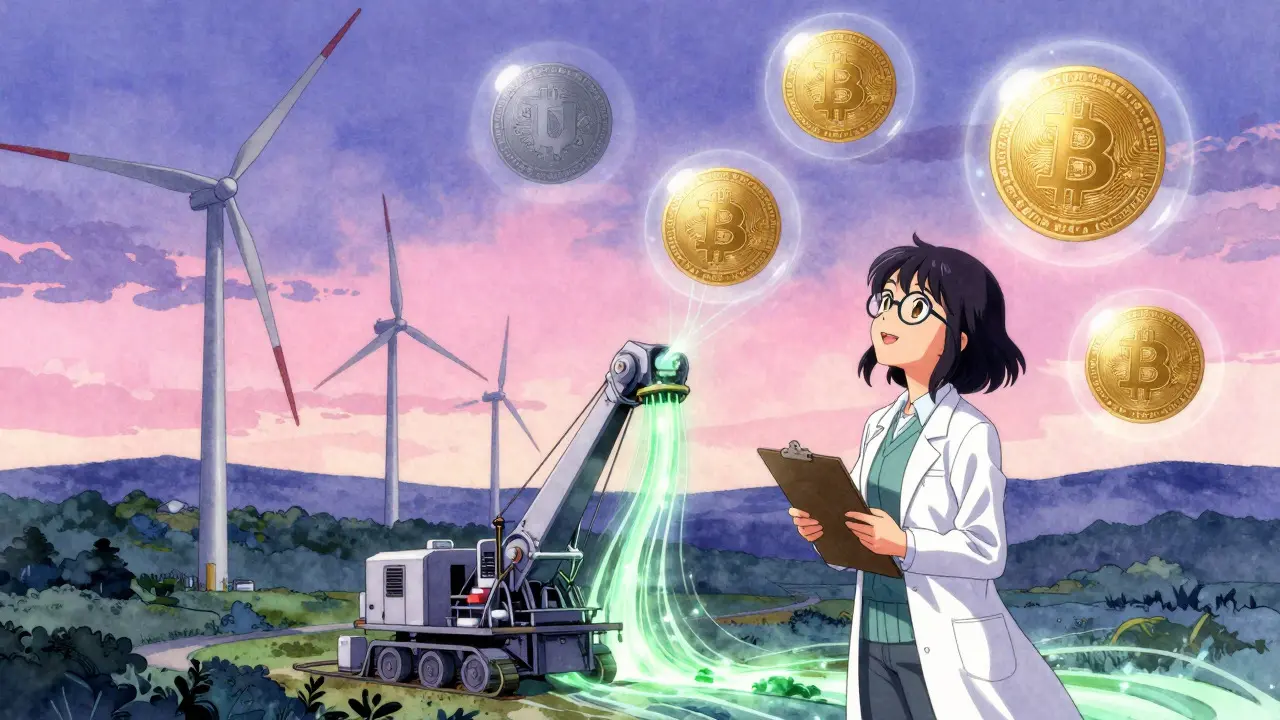
Cryptocurrency mining has faced criticism for its energy consumption. Critics argue that burning megawatts of electricity to secure a digital asset is wasteful. Proponents counter that mining acts as a sink for surplus renewable energy, utilizing power that would otherwise go unused. As of 2026, the industry is increasingly shifting toward green energy sources. Many large-scale operations now locate near hydroelectric dams or wind farms to minimize carbon footprint.
Looking ahead, technological advancements continue to improve hash-per-watt ratios. Next-generation ASICs are becoming more efficient, meaning you get more computing power for the same amount of electricity. Meanwhile, some major networks are exploring hybrid models or transitioning to Proof of Stake (PoS) to reduce energy needs entirely. However, Bitcoin remains firmly committed to PoW, viewing the energy expenditure as a feature, not a bug, due to its robust security guarantees.
Getting Started: Your Action Plan
If you’re ready to dive in, here is a practical checklist to ensure you don’t waste money:
- Calculate Local Power Costs: Know your exact rate per kilowatt-hour. This is your baseline for profitability.
- Select Hardware Wisely: Research current hash rates and energy consumption of available ASICs or GPUs. Don’t buy outdated models.
- Choose a Reliable Pool: Look for pools with a good track record, low latency, and transparent fee structures.
- Set Up Cooling: Invest in proper ventilation or air conditioning. Overheating kills hardware faster than anything else.
- Monitor Performance: Use dashboard tools to track your hashrate, uptime, and earnings in real-time.
Start small if possible. Test your setup with a single unit before scaling up. Mining is a dynamic field; staying informed about network difficulty adjustments and market trends will help you adapt quickly.
Is cryptocurrency mining still profitable in 2026?
Yes, but primarily for those with access to low-cost electricity. Home miners in high-power-rate regions may struggle to turn a profit after accounting for hardware depreciation. Industrial-scale operations and those using renewable energy sources generally maintain better margins.
What is the difference between mining and staking?
Mining uses computational power (Proof of Work) to validate transactions, requiring hardware and electricity. Staking involves locking up existing coins to validate blocks (Proof of Stake), requiring capital rather than processing power. Staking is generally more energy-efficient but offers lower entry barriers for new participants.
Do I need an ASIC to mine Bitcoin?
Effectively, yes. While technically possible with GPUs, the efficiency gap is so vast that GPU mining for Bitcoin is rarely profitable. ASICs are purpose-built for the SHA-256 algorithm and offer significantly higher hash rates per watt.
How often does mining difficulty change?
For Bitcoin, difficulty adjusts every 2,016 blocks, which typically occurs every two weeks. The adjustment aims to keep the average block time at 10 minutes. If blocks are found too quickly, difficulty increases; if too slowly, it decreases.
What happens when the block reward halves?
The block reward halving reduces the number of new coins issued per block. Historically, this event has reduced miner revenue, forcing less efficient miners out of the market while increasing the relative importance of transaction fees. It also tends to correlate with increased network security as remaining miners invest in better hardware.


22 Comments
Write a comment





Daniel Brown
August 19, 2026 AT 19:00Let’s cut the fluff here. You mention 'complex economic incentives' but fail to address the elephant in the room: the sheer capital expenditure required for entry. Most retail investors are priced out before they even plug in a cable. The barrier to entry isn't just technical; it's financial. If you can't secure power at under $0.04/kWh, you're not mining, you're donating to your utility company. It is a closed club now.
Dianne Ritter
August 21, 2026 AT 15:58I actually found this guide pretty balanced. I’ve been curious about how the mempool works since I started using Bitcoin for small purchases. It’s nice to see someone explain the difference between ASICs and GPUs without making one sound like magic and the other like trash. Both have their place depending on what coin you’re targeting. Good read overall.
Shawn Schaerer
August 22, 2026 AT 00:30One must consider the philosophical implications of Proof of Work beyond mere mechanics. Is energy consumption not the price of freedom from central authority? To dismiss PoW as wasteful is to misunderstand the nature of decentralized trust. We trade kilowatts for sovereignty. It is a noble sacrifice, albeit an expensive one. Do not let the green-washing narrative obscure the fundamental security model that keeps our digital gold safe from state interference. The cost is justified by the value of autonomy.
Hicham Mounir
August 23, 2026 AT 20:17Hey everyone! Just wanted to chime in because I think we all get so wrapped up in the hardware specs that we forget the human element. I remember when my first rig was just a couple of old graphics cards in my garage. It was loud, it was hot, and honestly, it barely made enough to cover the electricity bill. But the feeling of seeing that first satoshi hit my wallet? Pure magic. Don’t let the industrial scale scare you off if you want to try. Start small, learn the ropes, and maybe you’ll find a community around it too. It’s less about the money and more about the journey, right?
Sarah Campbell
August 24, 2026 AT 19:14Typical American arrogance 🇺🇸💰
They always think they can just buy their way into efficiency. In Europe, we have strict regulations for a reason! This whole 'mining' thing is basically gambling with extra steps. Who needs another pyramid scheme when we have actual banks? 😒
Phelan Deihl
August 25, 2026 AT 13:56The point about cooling solutions is often overlooked. I lost a GPU to thermal throttling last summer because I underestimated the heat output. Make sure you have proper airflow before you start crunching numbers.
michelle aguilar
August 27, 2026 AT 03:25Oh, dear, did we really need another 'beginner's guide' written by someone who clearly hasn't checked the current hash rate? The prose is... charmingly naive, I suppose. One might almost forgive the lack of depth if it weren't for the glaring omission of network difficulty adjustments' impact on long-term ROI. It reads like a blog post from 2018 that got stuck in a time warp. How daring of them to call it a 'practical' guide when practicality dictates buying used ASICs or simply HODLing instead. A bold, if somewhat misguided, attempt at education.
Lance Konig
August 27, 2026 AT 14:10You missed the most important part: the legal tax implications. In the US, every block reward is taxable income at the moment of receipt. Ignoring this will get you audited faster than you can say 'Satoshi'.
Dina Lazarova
August 29, 2026 AT 01:04It is rather tedious to read through such basic information, yet the author seems to believe the average reader requires this level of hand-holding. The comparison table is particularly uninspired, offering nothing new to those who have dabbled in the sector for more than a year. One expects a bit more nuance when discussing the environmental debate, rather than the standard 'green energy' platitude. Still, it serves its purpose for the truly novice, I suppose. A harmless, if somewhat patronizing, introduction to the field.
Nia Franklin
August 30, 2026 AT 01:28Omg, this is so helpful!! I've been wanting to get into mining but felt totally lost. The part about pools vs solo mining made so much sense to me. I think I'm gonna try starting with a small gpu rig in my spare room. Thanks for breaking it down so nicely! 💖✨
Mohamed Shoaeb
August 30, 2026 AT 19:17Great breakdown. I am based in India where electricity costs vary a lot by state. For us, the math usually doesn't work out unless you have solar. But the logic of the pool system is very clear. Thanks for the simple explanation.
Sonia Gomez Gomez
August 30, 2026 AT 21:38Did you know that mining farms in Texas are actually helping stabilize the grid during peak hours? :P
Also, why does everyone hate on ASICs? They are efficient! Stop being so anti-technology. The future is in silicon, people!
SHIV SHANKAR KANTA
August 31, 2026 AT 04:48The soul of the machine is not in the chip but in the will of the miner
we are not just solving equations we are forging the destiny of finance itself
let the doubters burn in their fiat prisons while we dig for digital gold
Marco Maldonado
August 31, 2026 AT 08:02Yea its all hype man. Look at the price action lately. Unless you bought hardware in 2020 you are underwater. Stop pretending this is a viable side hustle for normal people. Its for whales and rich guys with cheap power. Rest of us should just buy the coin and hold. Thats the only smart move. Don't waste your money on rigs that depreciate faster than a car.
Darren Moon
September 2, 2026 AT 06:34While the article touches upon the operational mechanics, it fails to adequately contextualize the macroeconomic volatility inherent in Proof-of-Work ecosystems. The correlation between hashrate expansion and market sentiment is non-linear and often counter-intuitive to the layperson. Furthermore, the assumption that transaction fees will compensate for halving events is a tenuous hypothesis given the current liquidity constraints in the broader crypto asset class. One must remain skeptical of any narrative that suggests profitability is a static variable rather than a dynamic equilibrium subject to exogenous shocks.
Quang Thai Tran
September 3, 2026 AT 15:20One must ask: who benefits from this decentralization? Certainly not the common man. The ASIC manufacturers are the true central banks of this new world. They control the supply of hashing power, effectively creating a cartel that dictates the rules of engagement. The 'open' network is a facade for a closed oligarchy of hardware vendors. Until we break free from this technological dependency, we remain slaves to the algorithm. Wake up, sheeple.
Kate Staab
September 4, 2026 AT 16:53It is simply immoral to burn so much energy for something that holds no intrinsic value. We are destroying the planet for a speculative bubble. The 'environmental impact' section is far too light on the actual carbon footprint. It is a moral failing of our generation to prioritize digital wealth over ecological stability. Shameful.
Tasha Davis
September 4, 2026 AT 17:01This is SO encouraging! I was scared to start but reading this makes me feel like I can do it! Let's go miners! 💪🚀 Keep pushing forward! The future is bright if we work together!
Abigail Sparks
September 5, 2026 AT 12:48Stop guessing and use a calculator. Here is the exact formula you need: (Hashrate * Reward / Network Hashrate) - Power Cost. If the number is negative, don't mine. Simple as that. Don't fall in love with the hardware. Fall in love with the profit margin. That's the only metric that matters. Now go do the math.
OLIVER CHRISTIAN
September 6, 2026 AT 02:00Welcome to the thread! Great discussion so far. I'd add that networking is key. Join some Discord servers or forums dedicated to specific coins. The knowledge sharing there is invaluable. Also, keep an eye on firmware updates for your hardware; they can sometimes improve efficiency by a few percent. Stay positive and keep learning. Happy mining!
Kelsey Anne
September 7, 2026 AT 01:11Profitability is a myth for retail. Halving kills margins. Fees won't save you. Buy low, sell high. Mining is for the industrials. Done.
Mike Baca
September 7, 2026 AT 05:24Man, i keep thinking about the big picture here. Like, is it even worth it if the network gets harder next month? Feels like a moving target. But then again, thats what makes it exciting right? The uncertainty is the spice of life. Or is it just risk? Idk. But i love the idea of securing my own money without asking a bank. Pretty wild concept when you think about it. Maybe ill try a little rig later. Who knows what happens next week anyway. The future is unwritten and that scares me a bit but also gets me pumped. Anyway, cool stuff.