Cloud Mining vs Home Mining: Which Is Right for You in 2026?

When you start thinking about mining Bitcoin or other cryptocurrencies, two paths appear: cloud mining and home mining. One promises ease - just pay and wait. The other demands effort - buying gear, wiring your home, and watching heat gauges. But which one actually makes sense today? By February 2026, the landscape has shifted. Electricity prices are higher in many places, ASIC miners are more efficient, and trust in cloud providers is thinner than ever. This isn’t about hype. It’s about real numbers, real risks, and what you can actually control.
What Is Cloud Mining, Really?
Cloud mining means renting hash power. You don’t own a single chip. Instead, you sign a contract with a company - say, Bitdeer or ViaBTC - and pay them to run mining hardware for you. They handle everything: the machines, the electricity, the cooling, even the software updates. All you do is log in and watch your balance grow.
It sounds simple. And for beginners, it is. You can get started in under 15 minutes. No tools. No wiring. No noise in your living room. But here’s the catch: you’re trusting someone else with your money. And that’s where things get risky.
According to the Blockchain Association’s 2024 Risk Assessment, 37% of cloud mining platforms don’t show proof they’re actually mining. Some just take your cash and disappear. In 2023, the IC3 reported average losses of $1,850 per victim of these scams. Even legitimate providers have issues. Users on Reddit and Trustpilot report contract terminations without warning, hash rate cuts without notice, and withdrawal delays that last weeks.
Costs? They’re hidden in plain sight. A 360-day contract for 150 TH/s from Bitdeer in late 2024 cost about $4,000 upfront. Add $0.08 per TH/s/day in maintenance fees - that’s another $4,320 over the year. Total? Around $8,320. Now, compare that to what you’d earn. At current Bitcoin prices and network difficulty, you’d net roughly $11,800 over that same period. Sounds good? Maybe. But that’s before taxes, before fees, before the platform changes terms.
What Does Home Mining Actually Require?
Home mining means you buy the hardware. You plug it in. You run it. You own it. The most common miner today is the Bitmain Antminer S21, which hits 190 TH/s and costs $3,200 new. Add a $300 power supply, $200 in cooling fans, and $500 for a dedicated circuit upgrade - you’re at $4,200 before you even turn it on.
But the real cost isn’t the machine. It’s electricity. If you’re paying $0.35 per kWh in Hawaii, you’ll burn through $1,500 a year just keeping one S21 running. That’s more than the machine cost. But if you’re in Washington State, where power is $0.04 per kWh? That same miner costs you just $170 a year in electricity. That’s why 63% of home miners operate in regions with rates below $0.10/kWh.
And it’s not plug-and-play. You need to know how to set up a static IP. You need to configure a mining pool like ViaBTC or F2Pool. You need to monitor temperature - these machines spit out 3,000+ BTUs of heat per hour. If your garage hits 40°C, the miner throttles, and your profits drop. A November 2024 survey of 1,247 home miners found 32% had PSU failures, 27% dealt with thermal throttling, and 19% couldn’t get their network to stay stable.
Still, the upside? Control. You can undervolt your ASIC to save 12-15% on power. You can switch pools if one starts paying less. You can sell the miner if Bitcoin crashes. You own the asset. And when Bitcoin doubles, your profit doubles - no middleman taking a cut.
Profitability: The Numbers Don’t Lie
Let’s compare two real scenarios from late 2024.
- Home Miner: Buys an Antminer S21 for $3,200. Pays $0.07/kWh electricity. Monthly profit after power: $150. ROI in 287 days. After one year: $1,800 net profit. Miner still works.
- Cloud Miner: Pays $4,000 for 150 TH/s for 360 days. Pays $4,320 in maintenance fees. Monthly profit after fees: $110. ROI in 340 days. After one year: $1,180 net profit. Then contract ends. You start over.
At $0.07/kWh, home mining beats cloud mining by 22%. But if your power costs $0.18/kWh? Now cloud mining pulls ahead - by 27%. The math is brutal: your electricity rate is the deciding factor.
Here’s the rule: If you pay more than $0.12/kWh, cloud mining is likely better. If you pay less than $0.09/kWh, home mining wins - if you can handle the hassle.
And don’t forget depreciation. ASICs die. The S19 series became unprofitable after 18 months. The S21? It’s already 12 months old. In 2026, your home miner might be worth $500 on eBay. Your cloud contract? Gone. Zero value.
Control vs Convenience: The Real Trade-Off
Cloud mining gives you convenience. You don’t care if the hardware is running. You don’t care if it’s in Kazakhstan or Iceland. You just get paid.
Home mining gives you freedom. You can tweak firmware. You can choose which pool to join. You can upgrade your power supply. You can even sell your miner to fund a new one.
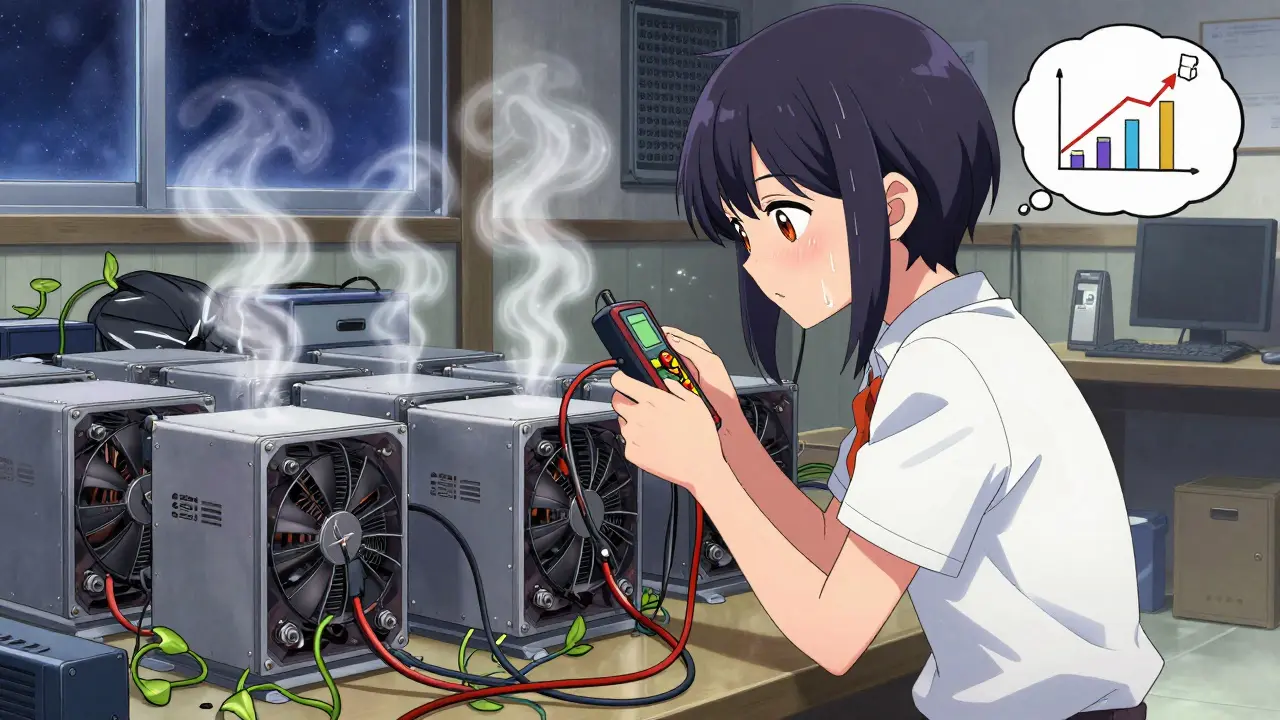
But control has a price. A home miner needs to know how to read a multimeter. They need to understand static IPs. They need to monitor logs. They need to be patient. One user on BitcoinTalk spent 57 hours in his first month just fixing a faulty PSU and reconfiguring his router. That’s not a hobby. That’s a second job.
Cloud mining? You get a dashboard. You click renew. You get an email if something breaks. But you can’t fix it. You can’t upgrade it. You can’t even choose which mining pool you’re on. Bitdeer’s contract (version 3.2, October 2024) locks you into their approved pools. No exceptions.
Regulation and Risk: What’s Changing in 2026
In 2025, California passed Assembly Bill 1816. It adds a $0.05/kWh surcharge on residential power use above 2,000 kWh/month. One S21 uses 3,500 kWh/year. That’s $175 extra per year - enough to kill home mining’s edge in the state.
Meanwhile, the SEC ruled in October 2024 that many cloud mining contracts are unregistered securities. Over 17 platforms stopped serving U.S. customers. The ones left? They’re the big ones: Bitdeer, ViaBTC, ECOS. But even they’re under scrutiny.
And then there’s sustainability. Bitdeer now offers carbon-neutral contracts - each 100 TH/s is backed by renewable energy credits. That’s good PR. But it doesn’t change the fact that you’re still paying for someone else’s infrastructure.
Home mining? No one regulates it. You can run a miner in your basement. No one knows. But if your power bill spikes, your utility might ask questions. And if your house catches fire from a faulty PSU? Insurance might not cover it.

Who Should Choose What?
Choose cloud mining if:
- You’re new to mining and don’t want to learn hardware
- You pay more than $0.12/kWh for electricity
- You don’t want to deal with noise, heat, or wiring
- You’re okay with lower long-term returns
Choose home mining if:
- You pay less than $0.09/kWh
- You’re comfortable with basic tech - routers, power strips, cooling
- You want to own an asset that might still have resale value
- You’re okay with occasional downtime and troubleshooting
There’s no middle ground. You can’t do both and expect to save money. One is a service. The other is a business.
What’s Next?
By 2027, Delphi Digital predicts cloud mining will grow to 35% of the market. But home mining won’t vanish. It’ll shrink - to a core group of tech-savvy operators in places like Texas, Georgia, and parts of Canada where power is cheap and regulations are light.
One thing’s clear: if you’re looking for passive income, cloud mining feels like it, but it’s not. You’re paying for a gamble. If you’re looking to build something real - something you can touch, fix, and sell - home mining still wins. It’s harder. It’s messier. But in 2026, it’s still the only way to truly own your mining.
Is cloud mining safe in 2026?
Only if you use one of the top five providers: Bitdeer, ViaBTC, NiceHash, ECOS, or HiveON. These are the only ones with verifiable mining infrastructure and transparent ownership. Avoid any platform that doesn’t show proof of mining or has no public contact info. In 2023, 63% of fraudulent mining sites operated under cloud mining pretenses.
Can I make money with home mining if I’m not tech-savvy?
It’s unlikely. Home mining requires basic electrical knowledge, networking setup, and troubleshooting skills. Over 78% of new home miners needed help during their first setup. If you can’t fix a router or replace a power supply, you’ll spend more on repairs than you earn. Start with a small miner and a guide from Bitmain or ViaBTC.
What’s the best ASIC miner for home mining in 2026?
The Bitmain Antminer S21 (190 TH/s) is still the top choice for new buyers. For used gear, the S19j Pro (100 TH/s) offers the best value - you can find them for $800-$1,200. Avoid older models like the S17 or S19 - they’re too power-hungry. Newer models like the Avalon A1466 Pro are quieter but less efficient.
Do I need a dedicated circuit for home mining?
Yes. A single S21 uses 3,500 watts. Most home circuits are 15-20 amps (1,800-2,400 watts). Running it on a regular outlet risks tripping breakers or starting a fire. Install a 240V, 30-amp dedicated circuit - it costs $500-$800 but is non-negotiable for safety.
Can I mine other coins with home mining?
Most modern ASICs like the S21 are designed only for Bitcoin. You can’t mine Ethereum, Litecoin, or Dogecoin with them. If you want to mine altcoins, you need GPU mining - which is far less profitable than ASIC mining for Bitcoin. Stick to Bitcoin if you’re using ASICs.


18 Comments
Write a comment

Will Lum
February 14, 2026 AT 11:42bala murali
February 16, 2026 AT 09:46Gaurav Mathur
February 17, 2026 AT 01:18Jeremy Lim
February 17, 2026 AT 15:24John Doyle
February 18, 2026 AT 07:48kelvin joseph-kanyin
February 19, 2026 AT 10:03Crystal McCoun
February 19, 2026 AT 13:34Elijah Young
February 19, 2026 AT 22:31Beth Trittschuh
February 21, 2026 AT 05:47Benjamin Andrew
February 23, 2026 AT 00:54Donna Patters
February 23, 2026 AT 07:30Michelle Cochran
February 23, 2026 AT 22:47monique mannino
February 25, 2026 AT 14:31Peggi shabaaz
February 25, 2026 AT 21:14Holly Perkins
February 25, 2026 AT 22:46Sanchita Nahar
February 26, 2026 AT 11:48Ben Pintilie
February 27, 2026 AT 08:49Sakshi Arora
February 28, 2026 AT 19:51