What is TrueUSD (TUSD) Crypto Coin? The Transparent USD Stablecoin Explained

TrueUSD, or TUSD, is a stablecoin that’s backed 1:1 by U.S. dollars. Unlike other cryptocurrencies that swing wildly in price, TUSD stays locked to $1.00 - and it’s built to prove it every single day. If you’ve ever worried about a crypto coin losing its value overnight, TUSD was made for you. It’s not a gamble. It’s a digital dollar you can hold on any blockchain.
How TUSD Keeps Its Value
TUSD doesn’t rely on algorithms, complex math, or market speculation to stay stable. It works like a digital bank account. When you deposit $1,000 into a trusted U.S. bank account managed by Archblock (the company behind TUSD), exactly 1,000 TUSD tokens are created and sent to your wallet. When you want cash back, you send the TUSD to a redemption address, and within one business day, you get $1,000 wired to your bank.
That’s it. No magic. No hidden layers. Just dollars in, tokens out. And because every dollar is held in FDIC-insured accounts, your TUSD is as safe as money in a U.S. bank - but usable on blockchains around the world.
Transparency That Actually Works
What makes TUSD different isn’t just that it’s backed by dollars - it’s that you can see proof, every day.
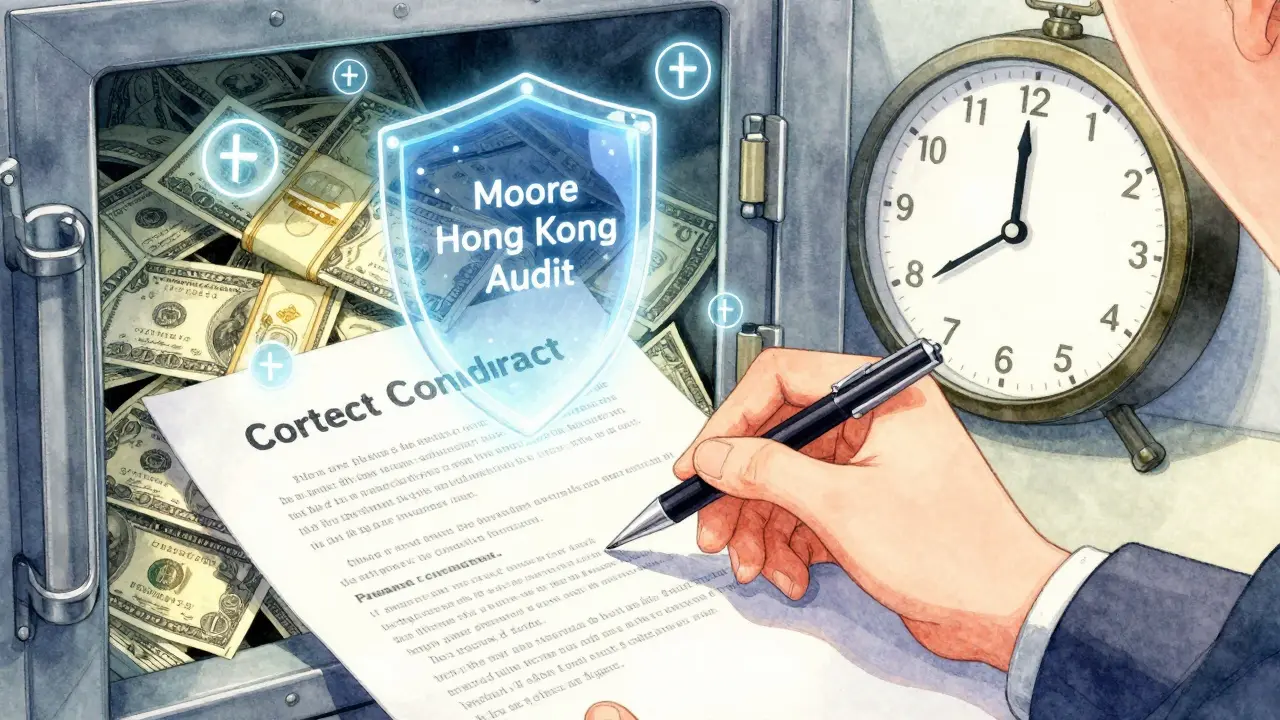
Most stablecoins, like USDT or even USDC, publish reserve reports once a month or quarter. TUSD goes further. Every 24 hours, an independent accounting firm - Moore Hong Kong - audits the total amount of TUSD in circulation and compares it to the U.S. dollars held in trust accounts. These reports are public, verifiable, and posted online. No guesswork. No delays.
This daily attestation system was a game-changer after the TerraUSD collapse in 2022 and the USDC depeg in March 2023. People lost trust in stablecoins that didn’t show their work. TUSD answered with transparency you can check in real time, using Chainlink’s Proof of Reserves technology. You can look up TUSD’s current reserve status on-chain, anytime.
Where TUSD Works
TUSD isn’t stuck on one blockchain. It runs on Ethereum as an ERC-20 token, but it’s also live on TRON, Avalanche, BNB Chain, Fantom, and Polygon. That means you can send TUSD across networks without converting it to another coin first. If you’re trading on Binance Smart Chain or using a DeFi app on Polygon, TUSD works natively.
This multi-chain support cuts costs and speeds up transfers. One user on Reddit reported moving TUSD from Ethereum to BNB Chain in 47 seconds - a transfer that would’ve taken hours with USDC due to gas fees and network congestion.
Each transaction costs just $0.01 to send, making it ideal for cross-border payments, remittances, or even small DeFi trades. No need to pay $5 in Ethereum gas fees just to move $10.
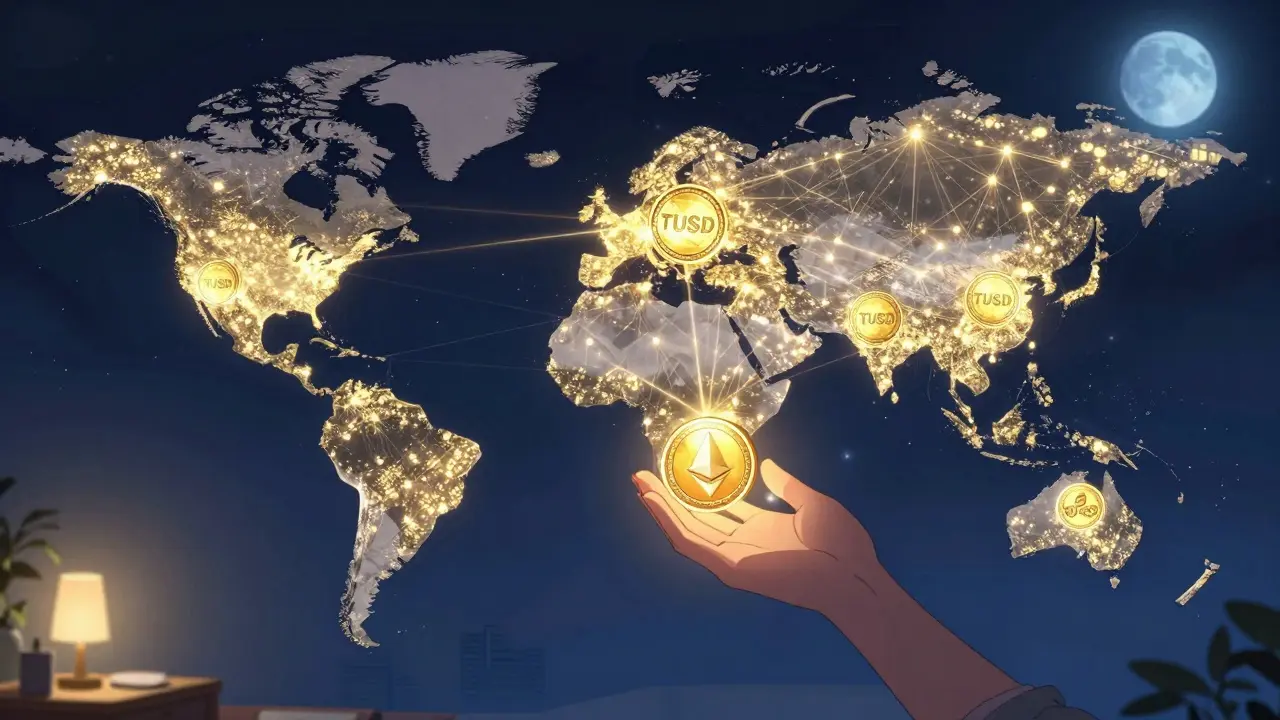
How TUSD Compares to Other Stablecoins
Let’s break it down:
| Feature | TrueUSD (TUSD) | USDC (Circle) | USDT (Tether) | DAI |
|---|---|---|---|---|
| Backing | 100% U.S. dollars | 100% U.S. dollars | ~3% cash, rest other assets | Overcollateralized crypto |
| Reserve Audits | Daily | Monthly | Quarterly (opaque) | Continuous (on-chain) |
| Blockchain Support | 6+ chains | 5+ chains | 15+ chains | 10+ chains |
| KYC Required? | Yes (redemption) | Yes (for large amounts) | No | No |
| Market Cap (Jan 2026) | $1.2 billion | $35 billion | $110 billion | $5.2 billion |
TUSD trades at $0.9995 as of March 2026 - almost perfectly pegged. That’s better than most. USDT’s reserves have been questioned for years, with only a small fraction in cash. USDC had a moment of instability in 2023 when banks froze assets. TUSD didn’t blink. Its reserves are clean, simple, and checked daily.
But there’s a trade-off. To redeem TUSD for cash, you need to complete KYC (Know Your Customer) checks. That means showing ID, proof of address, and sometimes even a selfie. USDT doesn’t require this - which is why it’s still popular in places where anonymity matters. But if you care about safety and accountability, TUSD’s KYC is a feature, not a bug.
Who Uses TUSD?
TUSD isn’t just for traders. It’s growing fast in emerging markets. Chainalysis data shows 37% of TUSD transactions come from Asia-Pacific countries - higher than USDC or USDT. Why? Because people there want stable value, not volatility. TUSD lets them store savings, pay freelancers, or send money home without risking a 20% drop in a day.
Institutional adoption is rising too. As of January 2026, 47 major exchanges list TUSD, including Binance, Coinbase, and Kraken. It’s supported in 187 trading pairs. That’s not as many as USDT, but it’s growing at 18% year-over-year since 2023.
The EU’s MiCA regulations, which took effect in June 2024, require stablecoins to prove daily reserves and hold 100% cash backing. TUSD already met those rules - giving it a legal edge in Europe. New York’s Department of Financial Services even added TUSD to its approved stablecoin list in December 2024.
What’s Next for TUSD?
Archblock has big plans. In late 2025, they announced integration with the FedNow system - the U.S. Federal Reserve’s instant payment network. That means TUSD reserves could one day be directly linked to U.S. central bank infrastructure. Imagine sending TUSD and having it settle like a bank wire - but on a blockchain.
By 2026, TUSD will expand to Solana, Cardano, and Polkadot. They’re also testing zero-knowledge proofs to let institutions verify reserves without revealing private details. That’s a big deal for hedge funds and asset managers who need transparency but can’t expose their holdings.
Gartner predicts TUSD will capture 8-10% of the stablecoin market by 2028. That’s up from 6.2% in 2025. Moody’s gave it an A2 rating - the highest possible - calling it one of the most reliable digital assets in crypto.
Is TUSD Right for You?
If you want:
- A stablecoin that proves its backing every day
- Low-cost transfers across multiple blockchains
- Security during market crashes (TUSD held $1.00 when USDC dipped to $0.98 in March 2025)
- Regulatory compliance and institutional trust
Then TUSD is a top choice.
If you want:
- Instant, anonymous transfers
- Maximum liquidity on every exchange
- No ID checks
Then USDT might suit you better - but you’re trading transparency for convenience.
Most users who switched from USDC or USDT to TUSD after the 2023 crypto turmoil say they’ll never go back. One Reddit user put it simply: "I don’t care if it’s slower. I care if it’s real. TUSD is real."
Is TrueUSD (TUSD) really backed 1:1 by U.S. dollars?
Yes. Every TUSD token is backed by one U.S. dollar held in FDIC-insured bank accounts managed by regulated financial partners. These reserves are verified daily by Moore Hong Kong, an independent accounting firm. You can view the latest attestation reports online, and Chainlink’s on-chain verification confirms the reserves match the circulating supply in real time.
How is TUSD different from USDT or USDC?
TUSD stands out because it publishes daily attestations of its reserves - unlike USDT, which rarely discloses its reserve composition, or USDC, which only audits monthly. TUSD also holds 100% cash reserves, while USDT’s reserves include commercial paper and other assets. TUSD is more transparent, but requires KYC for redemptions, unlike USDT.
Can I redeem TUSD for real U.S. dollars?
Yes. You can redeem TUSD for U.S. dollars through Archblock’s platform or partner exchanges. After sending your TUSD to the redemption address and completing KYC, you’ll receive a wire transfer within one business day. The process is reliable - 92% of users report successful withdrawals on time, according to Trustpilot reviews.
Why does TUSD need KYC? Isn’t crypto supposed to be anonymous?
KYC is required because TUSD is a regulated stablecoin tied to U.S. dollars. To prevent money laundering and comply with financial laws, Archblock must verify users before allowing fiat redemptions. This isn’t a flaw - it’s what makes TUSD trustworthy. USDT avoids KYC, but that’s also why regulators are wary of it. TUSD’s compliance is part of its strength.
Is TUSD safe during a crypto crash?
Yes. During the March 2025 market crash, USDC briefly dropped to $0.98 due to bank freezes. TUSD held its $1.00 peg because its reserves were fully liquid and independently verified. Its transparency and cash backing made it a safe haven for traders who moved their stablecoin holdings to TUSD during the panic.
Can I use TUSD on MetaMask or Trust Wallet?
Yes. TUSD is compatible with all major wallets that support ERC-20 and other EVM-compatible blockchains, including MetaMask, Trust Wallet, and Coinbase Wallet. Just add the TUSD token contract address for your chosen network (Ethereum, BNB Chain, etc.), and it will appear in your wallet.
What’s the transaction fee for sending TUSD?
The network fee for sending TUSD is $0.01 per transaction - far lower than Ethereum gas fees, which can exceed $5. This makes TUSD ideal for small payments, remittances, or frequent DeFi interactions. The fee is paid in the native token of the blockchain you’re using (e.g., ETH, BNB, MATIC), not in TUSD.
Is TUSD regulated?
Yes. TUSD is listed on the New York Department of Financial Services’ approved stablecoin list (December 2024). It complies with U.S. AML/KYC laws and meets the EU’s MiCA regulations for daily attestations and 1:1 backing. It’s one of the few stablecoins with formal regulatory recognition in both the U.S. and Europe.
18 Comments
Write a comment





Anshita Koul
March 10, 2026 AT 06:50Every time I see a stablecoin claim "1:1 backing," I roll my eyes-until I see TUSD's daily attestations. It's not just transparency; it's radical accountability. Moore Hong Kong doesn't just audit-they publish like clockwork. No delays. No smoke. Just cold, hard numbers. And yes, I check it every morning before coffee. I'm not a trader. I'm a saver. And TUSD? It's the only one I trust to hold value while the rest of crypto goes full circus.
PIYUSH KOTANGALE
March 11, 2026 AT 18:16Just moved my USDT to TUSD last week 😊
Anthony Marshall
March 11, 2026 AT 20:44USDT has 110B market cap because people don't care about your virtue signaling. TUSD is cute, but if you're not using it on Binance or OKX, you're just playing with digital Monopoly money. Get real.
Lindsay Girvan
March 11, 2026 AT 21:56Who cares if it's transparent? If you need KYC to redeem, you're not using crypto-you're using a bank with extra steps. The whole point of crypto is to bypass this garbage.
Howard Headlee
March 12, 2026 AT 17:15Let me tell you something-TUSD didn't just survive the 2023 crash. It thrived. While USDC was scrambling to explain why its bank account got frozen, TUSD sat there like a rock. $1.00. No wobble. No panic. Just clean, regulated, boring-as-hell stability. That’s the real innovation here: boring works. And people are finally waking up to it.
Julie Tomek
March 12, 2026 AT 19:24It is imperative to recognize that the structural integrity of TrueUSD’s operational model represents a paradigm shift in the evolution of digital asset infrastructure. The daily attestation protocol, facilitated by Moore Hong Kong in conjunction with Chainlink’s on-chain verification mechanisms, constitutes a verifiable, non-repudiable audit trail that fundamentally mitigates counterparty risk. Furthermore, the multi-chain interoperability architecture enables seamless liquidity migration across EVM-compatible networks, thereby enhancing capital efficiency for institutional actors engaged in cross-border settlement protocols. This is not merely a stablecoin-it is a regulatory-compliant financial instrument redefining the boundaries of decentralized finance.
Brandon Kaufman
March 13, 2026 AT 23:54I used to think stablecoins were all the same. Then I got burned by USDC during that bank panic. I switched to TUSD because I wanted to know, for sure, that my money was safe. And now? I use it to pay my freelance designer in India. No drama. No delays. Just $1.00 worth of value, every time. Honestly? It’s the quiet hero of crypto.
Zephora Zonum
March 15, 2026 AT 21:22Oh wow daily audits how revolutionary. Next you'll tell me the sky is blue. Everyone knows the big banks control the reserves. This is just another Wall Street puppet with a blockchain wrapper. The real money is in USDT because it doesn't ask for your birth certificate. TUSD? More like T-Used-To-Be-Trustworthy
Douglas Anderson
March 15, 2026 AT 22:04I've used TUSD for remittances to my family in the Philippines. No one else comes close. USDT? Too sketchy. USDC? Too slow to redeem. TUSD? $0.01 fee, 47-second transfer, and I actually got my money. No one's lying. No one's hiding. It just works. I don't need hype. I need reliability.
Tina Keller
March 16, 2026 AT 01:54As someone who grew up in a country where inflation ate savings alive, TUSD is more than a token-it’s dignity. My aunt in Lagos uses it to send money to her grandchildren. No middlemen. No exchange rates that change by the hour. Just dollars, digital and dependable. TUSD doesn’t just move money. It moves hope. And that? That’s worth more than any market cap.
ann neumann
March 16, 2026 AT 04:51They say TUSD is backed by dollars-but who really owns those banks? The same Fed that printed trillions. The same system that crashed in '08 and bailed out the rich. This isn't transparency-it's a distraction. They want you to think you're safe while they quietly rehypothecate everything behind closed doors. TUSD? It's a Trojan horse. Wait until the next crisis. You'll see. They'll freeze the reserves and blame 'market conditions.'
William Montgomery
March 18, 2026 AT 04:42Who even uses TUSD? You need KYC to redeem? That's not crypto. That's a bank account with a blockchain sticker. If you're not using USDT because it's anonymous, you're doing it wrong. Privacy isn't a bug-it's the whole point.
Mara Alves Mariano
March 19, 2026 AT 23:42Oh wow, a stablecoin that follows rules? How quaint. America thinks regulation = safety. In the real world, freedom means no ID checks. TUSD is for people who still trust the system. I use USDT because I don't need your permission to own money. You want to play by the rules? Fine. I'll be over here, free.
Adam Ashworth
March 21, 2026 AT 12:59Just want to say-TUSD’s multi-chain support is underrated. I use it on Polygon for DeFi yields and on BNB Chain for swaps. No bridging. No slippage. Just plug and play. It’s not the flashiest, but it’s the most reliable. I’ve switched everything to TUSD. No regrets.
Allison Davis
March 22, 2026 AT 07:53For anyone considering TUSD: check the daily attestations yourself. Go to Chainlink’s Proof of Reserves page. Type in TUSD. Watch the numbers update. It’s real. It’s live. And yes, it’s safer than your savings account.
Tom Jewell
March 23, 2026 AT 12:54There’s a quiet beauty in something that doesn’t try to be revolutionary. TUSD doesn’t need to be the biggest. It doesn’t need to be the most traded. It just needs to be honest. And in a world full of noise, that’s the rarest thing of all.
karan narware
March 24, 2026 AT 12:17India’s using TUSD more than USDC? Of course. We’ve seen too many scams. You want to save? You don’t want hype. You want proof. TUSD gives that. And yes, KYC? Good. I’d rather be safe than sorry. Let the Americans argue about privacy-we’re just trying to keep our money.
Michael Suttle
March 25, 2026 AT 03:44They’re all lying. Every single one. The daily audits? Fake. The FDIC insurance? A joke. The real reserves? Held in shell companies in the Caymans. TUSD is just the latest PR stunt from the same old players. Wake up. The system is rigged. You think they’d let a transparent stablecoin succeed? Please.