What is Succinct (PROVE)? A Guide to the Decentralized Prover Network
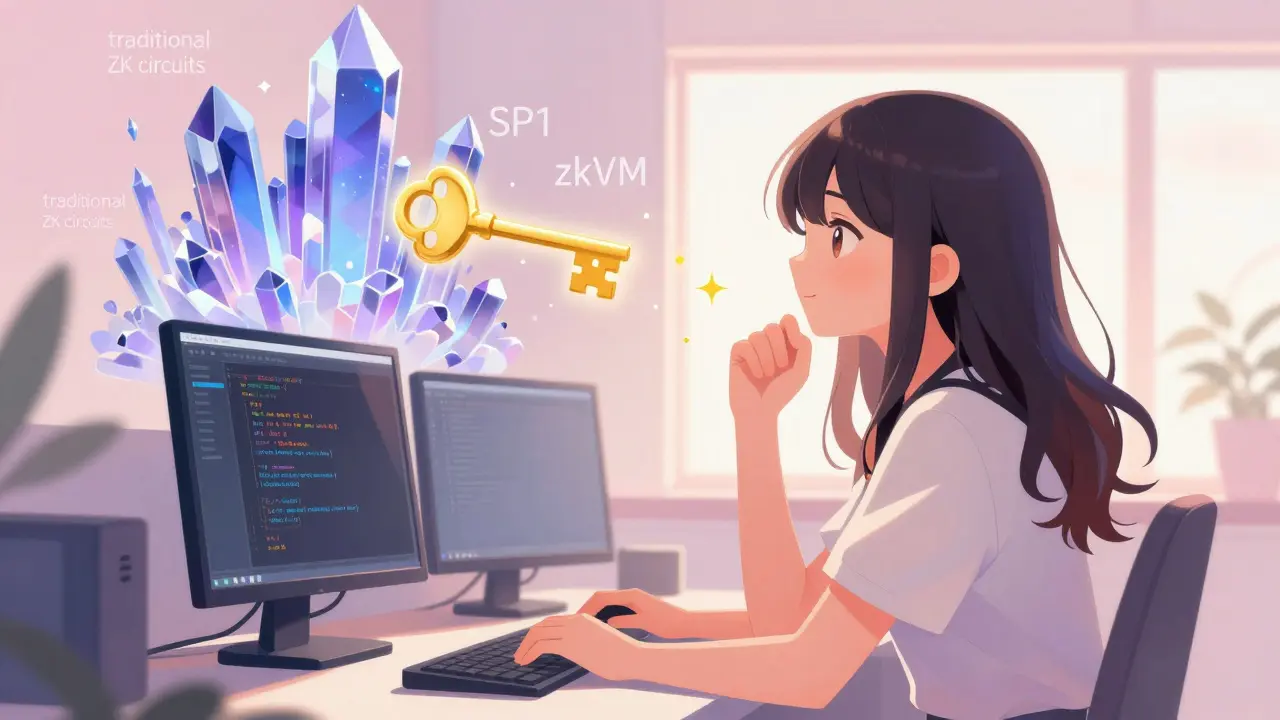
Imagine needing a high-tech security seal for a digital document, but building the machine to make that seal takes months of expert engineering and costs a fortune. That is exactly the problem Succinct is solving. Most developers struggle with Zero-Knowledge Proofs (ZKPs) because they are incredibly complex to build. Succinct turns this nightmare into a simple marketplace where anyone can get the proofs they need without becoming a cryptography PhD.
At its core, Succinct is a decentralized prover network built on Ethereum. It acts as a bridge between people who need proofs (requesters) and people with the computing power to generate them (provers). Instead of every project building its own expensive infrastructure, they just outsource the work to this network. The Succinct PROVE token is the fuel that makes this entire machine run, handling everything from payments to network security.
The Magic Behind the Scenes: SP1 and the Prover Network
To understand why this matters, you have to look at the SP1 zkVM. In the past, writing ZK programs meant creating complex "circuits," which is a tedious process that can take months. The SP1 is a general-purpose zero-knowledge virtual machine that lets developers write in Rust-a language they already know. This shifts the development timeline from months to mere days.
Once the code is written, it goes to the Prover Network. This isn't just one big server; it is a global collection of GPUs and data centers. To keep things fair and cheap, Succinct uses "Proof Contests." These are essentially all-pay auctions. Provers compete to generate the proof most efficiently, which drives down costs for the developer while ensuring the network stays decentralized. If a prover fails to meet a deadline or submits a faulty proof, they face penalties, ensuring only high-quality work gets through.
| Feature | Traditional ZK Systems | Succinct Network |
|---|---|---|
| Development Time | Months (Custom Circuits) | Days (Rust via SP1) |
| Cost Structure | High Fixed Infrastructure Costs | Variable, Market-Driven Costs |
| Proof Generation Speed | 5-15 Seconds (Dedicated) | 15-45 Seconds (Decentralized) |
| Accessibility | Requires Specialized Experts | Open Marketplace |
Understanding the PROVE Token: Utility and Value
The PROVE token is an ERC-20 asset with a maximum supply of 1 billion units. It isn't just a speculative coin; it has three very specific jobs within the ecosystem.
- Payment: Requesters use PROVE to pay the provers who generate their ZKPs.
- Staking: To participate in a proof contest, provers must lock up a minimum amount of PROVE. This acts as a security deposit; if they cheat or fail, they lose a portion of their stake.
- Capacity Control: The amount of PROVE a prover stakes determines how many auctions they can participate in at once, preventing a few giant players from monopolizing the network.
For regular users, the network also offers delegated staking. This allows people to earn rewards from network activity without actually running the heavy hardware required to generate proofs. As of late 2024, the average annual percentage rate (APR) for active provers sat around 14.3%, making it an attractive option for those with the right hardware.

Real-World Impact: Bridges, AI, and Gaming
Succinct isn't just a theoretical project; it's already powering a huge chunk of the ZK world. One of the most critical uses is in blockchain bridges. Because bridges move assets between different chains, they need a way to prove that a transaction actually happened on the other side without trusting a middleman. Succinct currently powers 12 major bridges, making them faster and more secure.
Another huge win is the partnership with Mantle Network. By using Succinct's shared proving marketplace, Mantle reduced transaction fees by 42% and boosted processing speeds by over 3x. Then there is Galxe, which used the network to run ZK raffles with over 1.2 million verifiable entries, proving that the system can handle massive scale without a single dispute.
Looking forward, we are seeing a push toward verifiable AI. Imagine an AI agent that doesn't just give you an answer, but provides a cryptographic proof that it actually followed a specific set of data and logic to get there. That is the kind of "verifiable computation" where Succinct's architecture excels.

The Trade-offs: Is it Right for Every Project?
No technology is perfect, and Succinct has a few Achilles' heels. The biggest one is latency. Because it uses a decentralized auction system, it takes longer to generate a proof (15-45 seconds) than a dedicated, centralized prover (5-15 seconds). If you are running a high-frequency trading bot where every millisecond counts, Succinct might be too slow. In fact, about 37% of high-frequency trading projects that tried it ended up switching back to specialized solutions.
There is also a bit of a learning curve. While Rust is common, setting up the perfect staking amount and auction parameters can be tricky for new provers. However, the community is growing fast, with a Discord of over 14,000 members and a robust set of GitHub repositories to help newcomers get their bearings.
What to Expect Next from Succinct
The roadmap for 2025 and 2026 focuses on making the network even cheaper and more autonomous. One major update is "Proof Aggregation as a Service," which batches multiple proofs together. This is expected to slash costs by another 30% to 50%.
We are also moving away from a "security council" (a small group of experts) toward full community governance. By mid-2025, token holders will have more say in how the protocol evolves. Additionally, a new reputation system is being built to work alongside staking, rewarding provers who have a long history of reliability, not just those with the most money.
What exactly is the PROVE token used for?
The PROVE token is used as payment for provers who generate zero-knowledge proofs, as a stake to ensure provers act honestly, and to determine the number of concurrent auctions a prover can enter.
How does Succinct make ZK proofs easier for developers?
Through the SP1 zkVM, which allows developers to write programs in Rust instead of designing complex cryptographic circuits from scratch, reducing development time from months to days.
Is Succinct better than centralized proving services?
It depends on your needs. Succinct is significantly cheaper (up to 67% less) and more decentralized, but it has higher latency (15-45 seconds) compared to dedicated centralized systems (5-15 seconds).
Can anyone become a prover on the network?
Yes, as long as you have the necessary computing power (like GPUs) and the required minimum stake of PROVE tokens to participate in the proof contests.
What is the maximum supply of PROVE tokens?
The PROVE token has a fixed maximum supply of 1,000,000,000 units.

14 Comments
Write a comment





Yuhan Mo
April 18, 2026 AT 09:47The abstraction provided by the SP1 zkVM is a game changer for the developer experience. Reducing the friction of circuit design by leveraging Rust effectively lowers the barrier to entry for complex cryptographic primitives. It is essentially commoditizing the prover layer while maintaining a decentralized trust model through the auction mechanism.
Trudy Morse
April 19, 2026 AT 00:29Decentralization is just a fancy word for slower speeds. We're trading efficiency for a feeling of security.
Prachi Bhadarge
April 20, 2026 AT 04:36Imagine actually thinking 45 seconds is fast enough for a modern app. Good luck with that latency lol.
Andrew Southgate
April 21, 2026 AT 01:29I totally see where you're coming from regarding the speed, but we have to remember that the trade-off is worth it for most projects that aren't doing high-frequency trading. For a bridge or a voting system, a few dozen seconds is nothing compared to the massive security gain of not having a centralized point of failure. Plus, the roadmap mentioned proof aggregation, which should really help bring those costs down and maybe optimize the pipeline further as the network matures and more GPUs join the fray. It is all about finding the right balance for the specific use case!
Ian Chait
April 21, 2026 AT 03:47Typical centrally-planned garbage. This whole "market-driven" cost thing is just a way for the whales to front-run the proofs. They'll use high-end ASIC rigs to crush any small-time prover, making the whole PROVE token ecosystem a giant rugpull waiting to happen. Just another layer of obfuscation for the elites to control the compute.
Evan Iacoboni
April 21, 2026 AT 14:21The all-pay auction model sounds like a recipe for a race to the bottom. If provers are just competing on price, the quality of hardware might drop over time to maintain margins.
Mark Pfeifer
April 22, 2026 AT 09:37Actually, the staking mechanism prevents that. If a prover submits a faulty proof just to win the auction, they lose their stake. That creates a strong economic incentive to maintain high-quality hardware and reliable software. It is a balanced system.
nikki krinkin
April 23, 2026 AT 06:10It is nice to see a project focusing on making the tech accessible to people who aren't PhDs.
Kim Smith
April 24, 2026 AT 08:44Its funny how we always chase this idea of decentralization like its the only way to find truth but maybe the real truth is in the transition period where we realize that most people just want things to work without caring who owns the server... tho i guess the verifiable AI part is actually pretty wild if you think about the implications for truth in the age of deepfakes and manipulated data streams where nothing is real anymore.
nathan jones
April 24, 2026 AT 18:44The Mantle results look solid.
Sean Douglas
April 26, 2026 AT 07:16The sheer audacity of calling a 45-second wait "efficient" is absolutely breathtaking. It is a digital purgatory! I can practically feel the agonizing slow-motion crawl of these proofs as they migrate through a network of GPUs that are probably overheating in some basement in Ohio. Pure, unadulterated torture for any developer with a shred of patience left in their soul.
Vicky Duffala
April 27, 2026 AT 19:13Let's look at the big picture! 🚀 The fact that we can now use Rust to build ZK proofs is a massive leap for the whole community. It opens the door for thousands of devs to start experimenting with verifiable computation without needing a degree in advanced math. This is how we actually scale the web3 dream, by making the hard parts easy! ✨
Keri Pommerenk
April 28, 2026 AT 11:45rust is definitely the way to go here. makes things so much smoother for the team
Adam Mann
April 30, 2026 AT 06:23I am just so happy to see more people getting involved in this space. It doesn't matter if the first version is a bit slow because the most important thing is that we are building a foundation that is open to everyone and doesn't just belong to a few big companies in Silicon Valley. If we can get the community to help refine the staking parameters and the reputation system, I truly believe this will be the backbone of a new, more honest internet where we can actually trust the data we see without having to trust the person who sent it to us, and that is a future I am really excited to be a part of with all of you!