What is Dragonchain (DRGN)? Disney’s Open-Source Blockchain Explained

Did you know that one of the most unique blockchain projects in existence was born inside The Walt Disney Company? It sounds like a plot twist from a movie, but it is actually the origin story of Dragonchain, a hybrid blockchain platform designed for enterprise security and public verification. If you have seen the ticker symbol DRGN on an exchange and wondered what makes it different from Bitcoin or Ethereum, you are not alone. Most people assume all blockchains work the same way, but Dragonchain takes a completely different approach by blending private corporate data with public blockchain proof.
This guide breaks down exactly what Dragonchain is, how its five-level node system works, and why it matters for businesses and developers. We will also look at the current state of the DRGN token, its utility beyond speculation, and whether this project still holds value in today’s crowded crypto market.
The Origin Story: From Disney to Open Source
To understand Dragonchain, you have to look back to 2014. Joe Roets, a developer working within Walt Disney Company's Seattle office, built a private blockchain platform for internal use. The goal was simple: create a secure, efficient way for large corporations to handle transactions without exposing sensitive business data to the public internet. This project was known internally as the Disney Private Blockchain Platform.
In October 2016, recognizing the broader potential of the technology, Disney open-sourced the code under the Apache 2.0 license. This move transformed a proprietary corporate tool into a community-driven project. In 2017, the team launched the initial coin offering (ICO) and officially rebranded the project as Dragonchain. Today, the Dragonchain Foundation, a non-profit organization led by Joe Roets steers the development, ensuring the platform remains neutral and focused on technological advancement rather than corporate profit.
This history is crucial because it shapes the platform’s DNA. Unlike many cryptocurrencies created purely for financial speculation, Dragonchain was engineered from day one to solve real-world enterprise problems like data privacy, scalability, and interoperability.
How the Hybrid Architecture Works
The core innovation of Dragonchain is its Hybrid Blockchain, a system that combines private enterprise nodes with public validation layers. Most blockchains force you to choose between privacy (private chains) and transparency (public chains). Dragonchain argues you can have both.
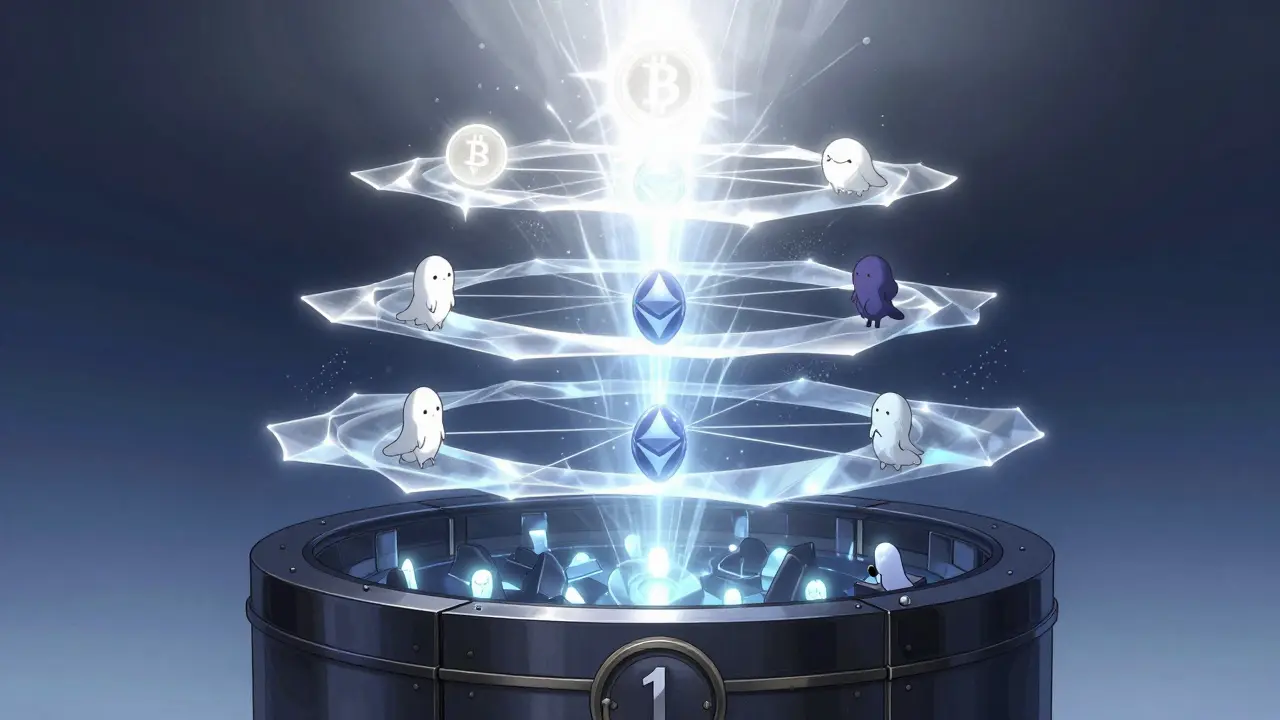
The platform uses a distinctive five-level consensus model to verify transactions. Here is how each level functions:
- Level 1 (Business Nodes): These are private servers owned by enterprises. Companies run their applications here, keeping their intellectual property and customer data completely confidential. No one outside the company sees this raw data.
- Level 2 (Validation Nodes): Managed by the Dragonchain community and partners, these nodes check if the Level 1 transactions follow the correct rules without seeing the actual content.
- Level 3 (Diversity Nodes): These provide additional validation checks to ensure no single entity controls the network, adding a layer of decentralization.
- Level 4 (Notary Nodes): Similar to Level 3, these nodes offer further verification and act as trusted third parties for complex transactions.
- Level 5 (Public Checkpoints): This is where the magic happens. Level 5 nodes post transaction proofs to major public blockchains like Bitcoin, Ethereum, and Binance Chain.
By anchoring data to public blockchains, Dragonchain provides undeniable proof that a transaction occurred at a specific time. However, because the actual business data stays on Level 1, companies maintain GDPR compliance and trade secret protection. This separation of "business data" from "blockchain proof" is often referred to as data camouflage.
Developer Flexibility and Interchain Technology
If you are a developer, you might be tired of learning a new, obscure programming language just to build a smart contract. Dragonchain solves this friction by supporting mainstream languages. You can write smart contracts in Python, JavaScript, Java, C++, Go, Ruby, PHP, and more.
This flexibility allows businesses to integrate blockchain into their existing tech stacks without hiring specialized blockchain engineers. It significantly reduces the cost and time required to deploy decentralized applications (dApps).
Another key feature is Interchain™ Technology, Dragonchain's cross-blockchain communication protocol. This technology allows Dragonchain to interact seamlessly with other networks. For example, a supply chain application on Dragonchain can trigger a payment on Ethereum or record a timestamp on Bitcoin. This interoperability ensures that Dragonchain is not an isolated island but part of a larger, connected web3 ecosystem.
| Feature | Dragonchain (DRGN) | Ethereum / Bitcoin |
|---|---|---|
| Data Privacy | High (Private L1 nodes) | Low (All data is public) |
| Programming Languages | Multi-language (Python, JS, Java, etc.) | Limited (Solidity, Rust, Script) |
| Consensus Model | 5-Level Hybrid Node System | Proof of Work / Proof of Stake |
| Primary Use Case | Enterprise & Supply Chain | Financial Store of Value / DeFi |
| GDPR Compliance | Supported via Data Camouflage | Difficult due to immutability |
The DRGN Token and TIME Loyalty System
The DRGN Token, the native cryptocurrency of the Dragonchain network serves two main purposes: facilitating transactions and rewarding network participants. Unlike Bitcoin, which relies on miners using heavy hardware to secure the network, Dragonchain does not have a traditional mining mechanism. Instead, it relies on a decentralized validation service provided by community members running Level 2, 3, and 4 nodes.
How do you get paid for running these nodes? Through the TIME Loyalty Score, a metric that determines reward distribution based on token holding duration. Here is how it works:
- You hold DRGN tokens in a non-exchange wallet (meaning you control the private keys).
- For every DRGN held, you earn 1 TIME score per day.
- Node runners stake their TIME scores when applying to validate transactions.
- Rewards are distributed proportionally based on the TIME scores applied.
This system incentivizes long-term holding. Since TIME accumulates over time, early adopters and long-term holders have a higher chance of earning rewards compared to those who buy and sell quickly. This creates a stable network infrastructure because operators are motivated to keep the network running securely over months and years, not just minutes.
As of recent market data, the circulating supply of DRGN is approximately 370 million tokens, with a maximum supply capped at 433.49 million. The token trades on various exchanges including Kucoin, Gate.io, and LCX, paired against assets like USDT, BTC, and ETH.
Real-World Applications and Enterprise Adoption
Why would a company choose Dragonchain over building their own private ledger? The answer lies in trust and verification. Imagine a pharmaceutical company tracking drugs from factory to pharmacy. They need to prove the drug is authentic (to prevent counterfeiting) but cannot reveal their supplier contracts or pricing strategies to competitors.
With Dragonchain, the pharma company runs the app on Level 1 (private). The hash of the batch number is posted to Level 5 (public Bitcoin/Ethereum). Anyone can verify that the batch exists and hasn't been tampered with, but they cannot see the commercial details. This balance is critical for industries like healthcare, finance, logistics, and government.
The platform also supports IoT (Internet of Things) integration. Smart devices can autonomously execute smart contracts on Dragonchain, enabling automated supply chain payments or environmental monitoring systems. The foundation actively incubates startups that build on top of this infrastructure, creating a growing ecosystem of practical dApps.

Market Performance and Current Status
Like many altcoins, DRGN has experienced significant price volatility. At its peak in mid-2018, following the ICO hype, the token traded above $0.60 with a market capitalization exceeding $140 million. However, as the broader crypto market corrected, so did Dragonchain.
In 2025 and early 2026, the price has stabilized in the lower range, often trading between $0.01 and $0.06 depending on market conditions. While the market cap may seem small compared to giants like Ethereum, this reflects Dragonchain’s niche focus. It is not trying to be a currency for buying coffee; it is a B2B (business-to-business) infrastructure tool.
Investors should note that Dragonchain’s value proposition is tied to its adoption by enterprises and developers, not just speculative trading volume. The continued development of the Dragon Net, the expansion of Interchain capabilities, and the maintenance of the open-source codebase by the Dragonchain Foundation indicate that the project is alive and evolving, despite being quieter than meme-coins.
Is Dragonchain Right for You?
If you are a developer looking to build scalable, private blockchain apps without reinventing the wheel, Dragonchain offers a compelling toolkit. Its support for standard languages and cloud environments makes it accessible. If you are an investor, DRGN represents a high-risk, high-reward play on enterprise blockchain adoption. It lacks the massive retail hype of Solana or Cardano, but it has a solid technical foundation and a clear use case.
The key takeaway is that Dragonchain bridges the gap between corporate secrecy and public accountability. In a world where data privacy laws are tightening and businesses demand transparency, that hybrid model is becoming increasingly valuable.
Who created Dragonchain?
Dragonchain was originally developed by Joe Roets while he was working at The Walt Disney Company's Seattle office in 2014. It was later open-sourced and is now governed by the non-profit Dragonchain Foundation.
Can I mine DRGN tokens?
No, Dragonchain does not use traditional mining. Instead, users earn rewards by running Level 2, 3, or 4 validation nodes and staking their TIME loyalty scores, which are generated by holding DRGN in a personal wallet.
What is the maximum supply of DRGN?
The maximum supply of Dragonchain tokens is capped at 433.49 million DRGN. As of recent updates, the circulating supply is approximately 370 million tokens.
How does Dragonchain ensure data privacy?
Dragonchain uses a hybrid architecture. Sensitive business data remains on private Level 1 nodes, while only cryptographic proofs of transactions are sent to public blockchains (Level 5). This allows for public verification without exposing confidential information.
Which programming languages does Dragonchain support?
Developers can write smart contracts on Dragonchain using popular languages such as Python, JavaScript, Java, C++, Go, Ruby, PHP, and C#. This flexibility helps reduce development time and costs.
Where can I buy DRGN?
DRGN is traded on several cryptocurrency exchanges including Kucoin, Gate.io, LCX Exchange, and Coinexchange. Common trading pairs include DRGN/USDT, DRGN/BTC, and DRGN/ETH.