What is Cerebro Protocol (CRX) Crypto Coin? Explained in Plain Terms

Ever tried buying a token on Ethereum using Solana coins? If you have, you know how messy it gets. You need five different wallets, three bridge services, and a checklist just to swap one token. That’s where Cerebro Protocol (CRX) comes in. It’s not another coin trying to be Bitcoin. It’s a tool designed to kill that complexity - all in one place.
What Cerebro Protocol Actually Does
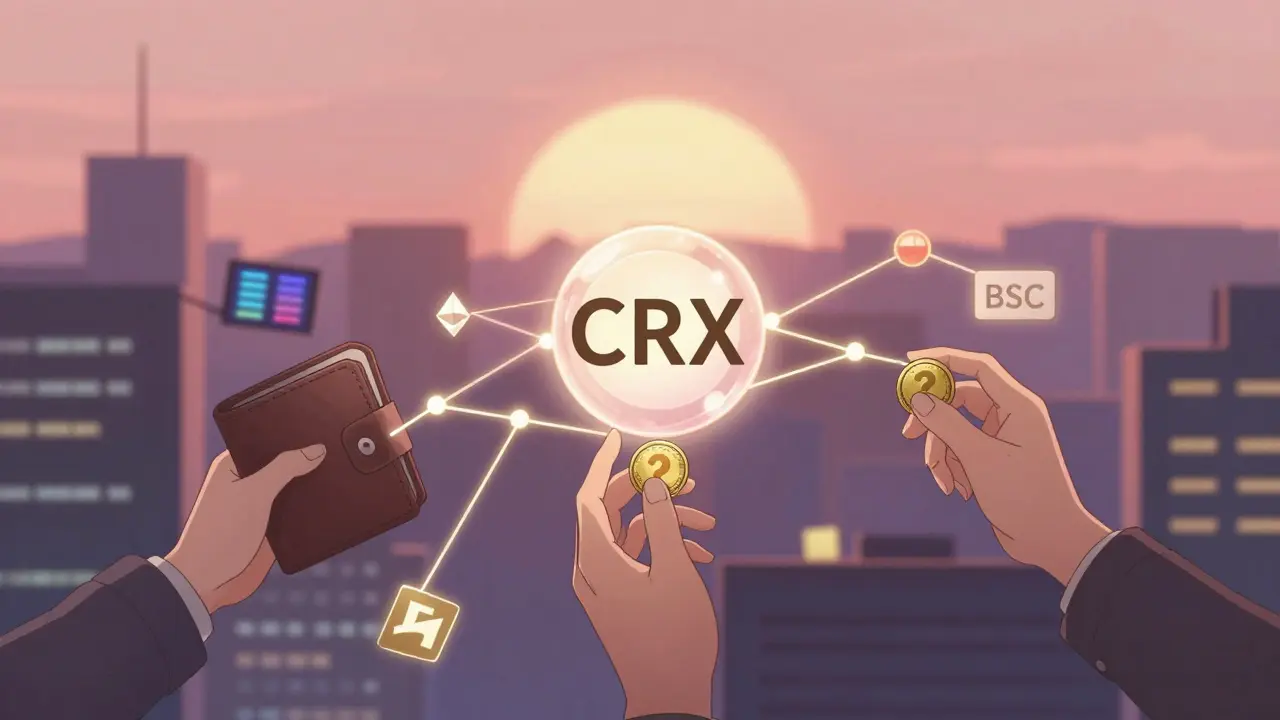
Cerebro Protocol (CRX) is a Web 3.0 platform that lets you trade, manage, and move crypto across different blockchains without switching apps. Think of it like a universal remote for your crypto portfolio. Instead of juggling MetaMask, Phantom, Trust Wallet, and three DEXs, you do everything inside Cerebro’s interface.
Here’s how it works: You have SOL in your wallet, but you want to buy PEPE, which lives on Ethereum. Normally, you’d have to convert SOL to USDT, bridge it to Ethereum, then swap it for PEPE. That’s three steps, three fees, and three chances for something to go wrong.
Cerebro skips all that. You select SOL as your source, PEPE as your target, and hit swap. The platform figures out the fastest, cheapest route - maybe using zkSync for speed, or another chain for lower fees - and executes it all in one transaction. No manual bridging. No wallet hopping.
The Tech Behind CRX
Cerebro doesn’t build its own blockchain. It layers on top of existing ones. Its backbone is zkSync, a Layer-2 solution that uses zero-knowledge proofs. This means transactions are fast (under 2 seconds), cheap (under $0.10), and private. Your trade history isn’t public on a blockchain explorer - only the final result.
On top of that, Cerebro uses its own system called CCC - Cross-Chain Communication. This isn’t just a bridge. It’s a smart router. It checks all major DEXs (Uniswap, SushiSwap, Jupiter, etc.), compares prices, gas fees, slippage, and liquidity across 15+ chains, then picks the best path. You don’t have to think about it. The AI does.
AI That Trades for You
This is where Cerebro stands out. Most crypto tools are just interfaces. Cerebro adds Large Language Models (LLMs) that watch markets 24/7. It doesn’t just show you charts. It tells you:
- "Your ETH position is at risk - liquidation probability is 68% if ETH drops below $3,100."
- "Yield on your USDC is 4.2% on Aave, but 5.8% on Compound. Switching saves you $18/month."
- "PEPE is trending on social media. Historical patterns show a 72% chance of +15% rally in next 48 hours."
These aren’t generic alerts. They’re personalized. The AI learns your risk tolerance, portfolio size, and trading habits. If you’re conservative, it ignores high-risk altcoins. If you’re aggressive, it flags emerging trends before they hit mainstream news.

Market Data as of March 2026
CRX is not a top-100 coin. But that doesn’t mean it’s dead. Here’s what the numbers show:
- Price: Around $0.0032 to $0.0111 USD - down over 99% from its all-time high of $0.60 in December 2024.
- Circulating Supply: 10,000,000 CRX (same as total and max supply - no more coins will be created).
- Market Cap: Between $149K and $0 depending on the exchange. Some platforms don’t even list it.
- Trading Volume: As low as $1.48K in 24 hours. That’s tiny. For comparison, a single popular meme coin trades $50M+ daily.
- Performance: Down 18% in the last week, 11% in 30 days. Meanwhile, Bitcoin rose 1.5% in the same period.
These numbers aren’t pretty. But they’re not unusual for a niche protocol. Many projects peak early, then struggle to gain real adoption. The fact that Cerebro still exists - with active listings on CoinMarketCap, CoinGecko, and Binance - suggests there’s still a user base. It’s not abandoned.
Where You Can Use CRX
You won’t find CRX on Coinbase or Crypto.com yet. But you can trade it on:
- Binance (via decentralized swap)
- CoinGecko (for price tracking)
- CoinMarketCap (for data)
- CryptoRank
- Decentralized exchanges like Uniswap and PancakeSwap
That means you can buy CRX, but you’ll need a wallet that supports Ethereum or BSC chains. Most people use MetaMask or Trust Wallet. You can’t buy it with a credit card on a centralized exchange - yet.
Is It Safe? Is It Legit?
Here’s the hard truth: We don’t know who built Cerebro Protocol. There’s no public team. No LinkedIn profiles. No official whitepaper. No founding date. That’s risky. In crypto, anonymity doesn’t always mean fraud - but it’s a red flag.
Security-wise, the use of zkSync is a good sign. zkSync has been audited by multiple firms and is used by major DeFi projects. Message signing (a standard crypto security practice) is also in place. But there’s no public audit report for Cerebro’s smart contracts. No bug bounty program. No GitHub activity logs.
So is it a scam? Not necessarily. But it’s not a fully transparent project either. If you’re considering holding CRX, treat it like a high-risk bet - not an investment.
Who Is This For?
Cerebro Protocol makes sense for three types of people:
- Traders who hate complexity: If you’re tired of managing 7 wallets and 3 bridges, this saves hours.
- AI-curious crypto users: If you like automated insights but don’t trust bots that promise 1000% returns, Cerebro’s AI is grounded in real portfolio data.
- Long-term believers in cross-chain: If you think the future is one wallet, one interface, all chains - then CRX is a small bet on that future.
It’s not for beginners who just bought Bitcoin. It’s not for day traders chasing pumps. It’s for people who want to simplify crypto without losing control.
The Bigger Picture
Cerebro isn’t the only player in this space. Projects like Synapse, LayerSwap, and Axelar also do cross-chain swaps. But most of them are just routers. Cerebro adds AI. That’s the differentiator.
But here’s the catch: AI in crypto is overhyped. Many platforms claim "AI-driven" but just show you candlestick patterns. Cerebro’s AI is more advanced - it analyzes off-chain data (social sentiment, on-chain liquidity shifts, wallet movements) to make suggestions. That’s rare.
Still, adoption is slow. The market doesn’t trust tools that can’t prove their value. Until CRX starts seeing real user growth - not just price listings - it’ll remain a niche tool.
Final Thoughts
Cerebro Protocol (CRX) is not a miracle coin. It’s not going to make you rich. But it solves a real problem: crypto’s fragmentation. If you’re tired of the chaos, it’s one of the few tools that actually tries to fix it.
Right now, it’s in survival mode. The price is low. Volume is thin. The team is quiet. But the tech? The cross-chain engine, the AI logic, the zkSync integration? That’s solid. If the team ever comes out of hiding and starts building - users might come back.
For now, treat CRX like a beta tool. Try it if you’re curious. Don’t invest more than you can afford to lose. And keep an eye on it. This could be one of those quiet projects that wakes up when the next crypto cycle hits.
Is Cerebro Protocol (CRX) a scam?
There’s no evidence CRX is a scam, but it’s also not fully transparent. The development team isn’t public, there’s no whitepaper, and no audits are published. That’s risky. It’s not a rug pull - yet - but it’s not a trusted project either. Treat it as high-risk.
Can I buy CRX with a credit card?
No, you can’t buy CRX directly with a credit card on major exchanges like Coinbase or Binance. You’ll need to first buy ETH or BNB on a centralized exchange, send it to your wallet, then trade for CRX on a decentralized exchange like Uniswap or PancakeSwap.
Why is CRX’s price so low?
CRX hit $0.60 in December 2024, but has since lost over 99% of its value. The main reasons are low trading volume, lack of marketing, no clear roadmap updates, and competition from better-known cross-chain tools. The market hasn’t seen enough adoption to justify higher prices.
Does Cerebro Protocol have a wallet?
No, Cerebro doesn’t have its own wallet. It works with existing wallets like MetaMask, Trust Wallet, or Phantom. You connect your wallet to the Cerebro platform, and it handles the cross-chain trades for you. You still control your private keys.
Is CRX listed on Binance?
Yes, CRX is listed on Binance - but only for trading via decentralized swaps. You won’t find it on the main spot market. You’ll need to use Binance’s DEX interface or connect your wallet to trade CRX there.
Can I use Cerebro Protocol without AI?
Yes. The AI features are optional. You can use Cerebro just as a cross-chain swap tool - like a better version of 1inch or Matcha. The AI gives you suggestions, but you can ignore them and manually confirm every trade.

25 Comments
Write a comment





Abhishek Thakur
March 24, 2026 AT 07:42Jackie Crusenberry
March 24, 2026 AT 19:15Neil MacLeod
March 25, 2026 AT 22:18Misty Williams
March 27, 2026 AT 04:58Anand Makawana
March 28, 2026 AT 12:51Mohammed Tahseen Shaikh
March 30, 2026 AT 06:30Sarah Terry
March 30, 2026 AT 15:49kavya barikar
March 31, 2026 AT 01:32namrata singh
April 1, 2026 AT 15:36Andrea Zaszczynski
April 1, 2026 AT 22:33Cordany Harper
April 2, 2026 AT 11:00Zion Banks
April 3, 2026 AT 18:15manoj kumar
April 4, 2026 AT 18:30JOHN NGEH
April 5, 2026 AT 03:52Jenni Moss
April 5, 2026 AT 21:57vu phung
April 7, 2026 AT 09:29Joshua T Berglan
April 9, 2026 AT 06:36Andrew Midwood
April 11, 2026 AT 00:10Kayla Thompson
April 12, 2026 AT 10:35Brijendra Kumar
April 13, 2026 AT 17:50Ananya Sharma
April 14, 2026 AT 21:30Alicia Speas
April 16, 2026 AT 17:52Justin Credible
April 17, 2026 AT 14:18Dheeraj Singh
April 18, 2026 AT 23:57Mike Yobra
April 20, 2026 AT 01:10