Understanding Blockchain Network Topology: How Nodes Connect and Why It Matters
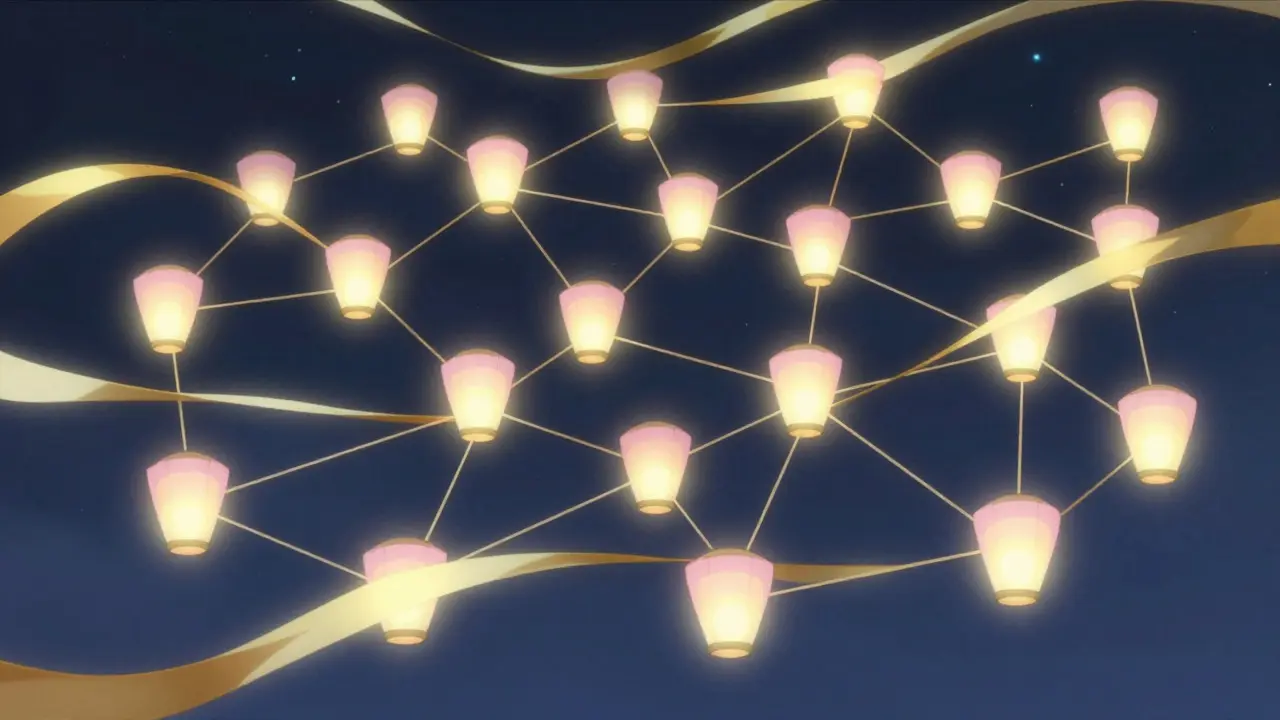
When you send Bitcoin from one wallet to another, it doesn’t just jump straight to the recipient. It travels through dozens, sometimes hundreds, of computers scattered across the globe. Each one of these computers is a node, and how they connect to each other is called blockchain network topology. This isn’t just technical jargon-it’s what keeps the whole system running, secure, and resistant to attacks. If the way nodes talk to each other is poorly designed, the network slows down, becomes vulnerable, or even collapses under pressure. Understanding this structure helps you see why some blockchains scale better than others, why some are more resistant to censorship, and why decentralization isn’t just a buzzword-it’s a design choice.
What Exactly Is Blockchain Network Topology?
Blockchain network topology is the layout of how nodes communicate. Think of it like the road system of a city. Some cities have one main highway everyone uses (a hub-and-spoke model). Others have a grid of streets where you can take multiple routes to get to the same place (a mesh). Blockchain networks work the same way. The topology determines how transaction data flows, how fast blocks are confirmed, and how hard it is for someone to cut off part of the network.
Unlike traditional banking, where transactions go through a central server, blockchain networks rely on thousands of independent machines-each holding a copy of the ledger. These machines don’t have a boss. They don’t report to a headquarters. They talk directly to each other. The way they form these connections is the topology. And it makes all the difference.
The Mesh Topology: Bitcoin’s Secret Weapon
Bitcoin uses what’s called a mesh topology. In this setup, every node connects to multiple other nodes-not just one or two. When a transaction happens, it doesn’t go to a central point. It spreads outward like ripples in a pond. The first node tells its five neighbors. Each of those tells their five neighbors. Within seconds, the transaction reaches hundreds of nodes. This isn’t just fast-it’s incredibly resilient.
Why does this matter? Because there’s no single point to attack. If one node goes offline, the network keeps going. If a government tries to block traffic from a specific region, the data finds another path. This is why Bitcoin has survived over 15 years of regulatory pressure, hacking attempts, and market crashes. The mesh topology doesn’t just support decentralization-it enforces it.
Studies show that Bitcoin’s network can broadcast a new block to over 90% of connected nodes in under two seconds. That speed isn’t accidental. It’s built into the topology. Other blockchains that use fewer connections per node take longer to propagate data, sometimes over 10 seconds. That delay creates opportunities for forks, reorganizations, and even double-spend attacks.
Router Topology: The Centralized Trap
Not all blockchains are built like Bitcoin. Some, especially private or enterprise chains, use a router topology. In this model, nodes connect to one central hub. All communication flows through that hub. It sounds efficient-until it isn’t.
This is the same model used by traditional banks. Every transaction goes through a central server. That makes it easier to control, monitor, and shut down. But it also makes it fragile. If the central router goes down-due to a server crash, a cyberattack, or a power outage-the entire network stalls. There’s no backup path. No fallback. Just silence.
Hyperledger Fabric, used by many corporations, relies on this structure. It’s useful for controlled environments where trust is assumed and access is restricted. But it defeats the purpose of blockchain if you need a central authority to keep things running. That’s why public blockchains avoid it. The moment you introduce a central router, you reintroduce the single point of failure that blockchain was designed to eliminate.
Ring Topology: A Middle Ground?
Another model, called ring topology, connects nodes in a circle. Each node talks only to its two neighbors. Data travels around the ring until it reaches its destination. This reduces the number of connections each node needs to maintain, which saves bandwidth and computing power.
It’s more efficient than a full mesh, but it’s also slower. If a node in the ring fails, data can’t flow past it unless there’s a bypass. Some newer blockchains experiment with this structure to reduce overhead, especially in mobile or low-power environments. But it’s not widely adopted in major public chains because it introduces latency and vulnerability. A single point of failure in the ring can break the whole loop.

Hierarchical and Tree Topologies: The Compromise
Some blockchains, especially those built for enterprise use, use hierarchical structures. Nodes are arranged in layers. Lower-level nodes report to higher-level ones, which then relay data to a central authority. This looks like a tree-root at the top, branches down below.
It’s faster for processing transactions because not every node needs to validate everything. But it’s also less decentralized. In these systems, a few nodes have more power than others. They can delay or even censor transactions. This isn’t a flaw-it’s by design. But it means you’re trading off openness for speed.
For example, a supply chain blockchain might use a tree topology so only approved suppliers and logistics partners can validate shipments. That works for corporate use. But if you’re trying to build a censorship-resistant currency, this structure is a dealbreaker.
Why Topology Affects Consensus
The way nodes are connected directly impacts how consensus works. Consensus is the process where nodes agree on which transactions are valid. If data takes too long to spread, nodes might not have the same information when they vote. That can lead to forks-where the blockchain splits into two versions.
Proof-of-Work blockchains like Bitcoin rely on fast propagation. Miners need to know about new blocks as quickly as possible so they can start building on top of them. If the network topology is slow, miners waste time working on outdated blocks. That’s wasted energy and lost rewards.
Proof-of-Stake chains like Ethereum have a similar problem. Validators need to see the latest state of the ledger to vote correctly. If the topology is poorly designed, validators might vote on different versions of history. This weakens security and opens the door to double-spending.
That’s why Ethereum’s consensus mechanism, Gasper, includes a built-in delay to account for network latency. It’s not a bug-it’s a feature. It gives the network time to stabilize before finalizing blocks. But that delay only works if the underlying topology is solid.
What Happens When Topology Fails?
There have been real-world cases where poor topology caused major issues. In 2021, a major cryptocurrency experienced a 45-second delay in block propagation due to nodes only connecting to three others. Miners on the east coast were working on blocks that miners on the west coast didn’t even know existed. The result? A chain split. Over $12 million in transactions were reversed before the network healed.
Another incident in 2023 involved a private blockchain that used a hub-and-spoke model. The central server was hit by a DDoS attack. All connected nodes went offline. No transactions could be processed for 14 hours. The company lost customer trust. They had to rebuild the entire network from scratch.
These aren’t theoretical risks. They’re real consequences of ignoring topology.

How to Evaluate a Blockchain’s Topology
If you’re choosing a blockchain to use-whether for investing, developing, or storing value-ask these questions:
- How many connections does each node have? More than five? That’s a good sign.
- Is there a central server or authority? If yes, how much control does it have?
- How fast do blocks propagate across the network? Look for public data on block confirmation times.
- Has the network ever experienced a fork due to slow propagation? Check the blockchain’s history.
- Are nodes geographically distributed? A network with nodes only in one country is more vulnerable to shutdowns.
A truly decentralized network doesn’t just say it’s decentralized-it proves it through its structure.
Future Trends in Network Topology
Researchers are testing new models to improve scalability without sacrificing decentralization. One promising approach is subnetwork clustering, where groups of nodes form mini-meshes that connect to each other. This reduces the load on individual nodes while keeping the overall network robust.
Another idea is adaptive topology, where nodes automatically adjust their connections based on traffic, location, and performance. Imagine your node switching to faster peers during peak hours-this is already being tested in experimental blockchains.
What’s clear is that the future of blockchain doesn’t lie in faster consensus algorithms alone. It lies in smarter networks. The best technology in the world won’t help if the way nodes talk to each other is broken.
Final Thought: It’s Not Just About Code
People focus on smart contracts, mining rewards, and tokenomics. But the real foundation of any blockchain is its network. The topology. The invisible web of connections that keeps everything alive. You can have the most advanced smart contract ever written, but if the nodes can’t talk to each other quickly and reliably, it’s useless.
When you hear someone say "blockchain is decentralized," don’t just accept it. Ask: "How?" Look at the topology. See how the nodes connect. Because decentralization isn’t a promise-it’s a structure.
What is the most common blockchain network topology?
The most common topology in public blockchains like Bitcoin and Ethereum is the mesh topology. In this setup, each node connects to multiple other nodes, creating a web-like structure. This design ensures no single point of failure and allows fast, resilient broadcast of transactions and blocks across the network.
Does blockchain topology affect transaction speed?
Yes. Topology directly impacts how quickly data spreads. In a mesh network, a transaction can reach thousands of nodes in under two seconds. In a hub-and-spoke or ring topology, delays can occur because data must pass through fewer or sequential connections. Slower propagation increases the risk of forks and reduces overall network efficiency.
Why do enterprise blockchains use centralized topologies?
Enterprise blockchains like Hyperledger Fabric often use router or hierarchical topologies because they prioritize control, privacy, and performance over decentralization. These models make it easier to audit transactions, restrict access, and manage compliance. But they sacrifice the censorship-resistant, trustless nature that defines public blockchains.
Can a blockchain be secure with a simple topology?
Not really. Simple topologies like star or ring reduce redundancy, making the network vulnerable to outages and attacks. Security in blockchain comes from redundancy-multiple paths for data to travel. Without that, a single node failure or targeted attack can disrupt the entire system.
How does topology influence decentralization?
Decentralization depends on how many independent participants can join and communicate without permission. A mesh topology allows anyone to connect directly to others, supporting true decentralization. Any topology with central hubs, gateways, or limited connections reduces participation and concentrates control, weakening decentralization.

25 Comments
Write a comment





Ace Crystal
February 11, 2026 AT 00:53Stop thinking of blockchain as a database. Think of it as a living organism. And topology? That's its nervous system.
blake blackner
February 11, 2026 AT 03:25Andrea Atzori
February 12, 2026 AT 23:24Enterprise chains? They’re like a choir with one lead singer. It sounds clean. But where’s the soul?
Robbi Hess
February 13, 2026 AT 13:25Keturah Hudson
February 14, 2026 AT 10:38krista muzer
February 15, 2026 AT 10:51Tammy Chew
February 15, 2026 AT 17:47Lindsey Elliott
February 16, 2026 AT 13:18kelvin joseph-kanyin
February 17, 2026 AT 20:43Michelle Cochran
February 18, 2026 AT 09:57Holly Perkins
February 18, 2026 AT 14:59Will Lum
February 20, 2026 AT 02:32Sanchita Nahar
February 20, 2026 AT 07:50Sakshi Arora
February 22, 2026 AT 05:41Elijah Young
February 23, 2026 AT 11:43Beth Trittschuh
February 25, 2026 AT 10:15And yes-I cried the first time my node synced with one in Ukraine. No words. Just data. But it meant everything.
Benjamin Andrew
February 27, 2026 AT 00:57monique mannino
February 28, 2026 AT 06:19bala murali
March 1, 2026 AT 00:26Santosh kumar
March 2, 2026 AT 00:37Joe Osowski
March 2, 2026 AT 03:41Grace Mugambi
March 3, 2026 AT 04:04Crystal McCoun
March 4, 2026 AT 16:40Peggi shabaaz
March 5, 2026 AT 05:25Ben Pintilie
March 5, 2026 AT 09:58