Tegro Crypto Exchange Review: Is This Web3 Gaming DEX Worth It?

Most crypto exchanges fall into one of two boxes: centralized giants like Binance or decentralized protocols like Uniswap. Tegro is a hybrid cross-chain DeFi platform that combines a decentralized orderbook exchange with a Web3 gaming marketplace and merchant payment infrastructure. It doesn't fit neatly into either category, which makes it an interesting but risky proposition for traders looking for something different from the standard automated market maker (AMM) model.
If you are searching for a Tegro review, you are likely evaluating whether this platform offers genuine utility or just another speculative token play. The short answer? It has ambitious features-specifically its non-custodial orderbook and gaming bounty system-but suffers from significant transparency gaps regarding security audits, trading volume, and regulatory status. Before you connect your wallet, here is what you need to know about how Tegro actually works, where it shines, and where you should tread carefully.
Key Takeaways
- Hybrid Model: Tegro is not a traditional CEX; it is a non-custodial DEX using an orderbook system rather than liquidity pools, supported by a native TGR token.
- Cross-Chain Focus: The platform primarily bridges assets between The Open Network (TON) and Binance Smart Chain (BSC).
- Gaming Integration: A unique feature is the "bounty system" connecting gamers who complete tasks (like leveling up in Axie Infinity) with posters paying for those services.
- Transparency Gaps: Public data on Total Value Locked (TVL), independent smart contract audits, and specific fee structures is currently limited or unavailable.
- Risk Profile: Suitable for high-risk tolerance users interested in Web3 gaming infrastructure; less ideal for conservative traders seeking deep liquidity and established track records.
What Exactly Is Tegro?
To understand Tegro, you have to look past the label "crypto exchange." It functions as a multi-layered ecosystem. At its core is a decentralized exchange (DEX) that uses an advanced orderbook system. Unlike Uniswap or PancakeSwap, which rely on Automated Market Makers (AMMs) where you swap against a pool of liquidity, Tegro matches buy and sell orders directly. This approach theoretically reduces slippage for large trades and provides more precise price discovery, similar to how traditional stock exchanges work, but without a central authority holding your funds.
The platform operates across two major blockchains: The Open Network (TON) and Binance Smart Chain (BSC). This cross-chain capability allows users to move assets between these networks seamlessly within the Tegro environment. The native currency of this ecosystem is the TGR token, which serves as the primary payment method for services, goods via Tegro Money, and bridged asset exchange. If you want to use the full suite of Tegro's features, holding TGR is likely necessary for gas fees and service payments.
Trading Experience: Orderbook vs. AMM
For traders, the biggest differentiator here is the orderbook. In a typical AMM DEX, if you sell a large amount of tokens, the price impact can be significant because you are pulling from a finite pool. In an orderbook system, you are matching with other users' limit orders. Tegro claims this setup enables "rapid trade execution" with robust Maximum Extractable Value (MEV) protection. MEV protection is critical in DeFi; it prevents sandwich attacks where bots front-run your transaction to profit at your expense. While the specific technical mechanism (e.g., private mempools or Flashbots integration) isn't fully detailed in public docs, the promise of MEV protection is a strong selling point for active traders.
One notable feature is "gasless quotes." This means you can view prices and place orders without immediately paying network gas fees for the quote generation phase. However, keep in mind that final execution will still require gas on the underlying chain (TON or BSC). The interface is designed with a sleek, dark theme aimed at high-frequency traders, prioritizing data visualization and real-time insights over flashy animations. If you are used to the clean, professional look of TradingView or institutional dashboards, Tegro’s trading UI will feel familiar.
The Web3 Gaming Marketplace & Bounty System
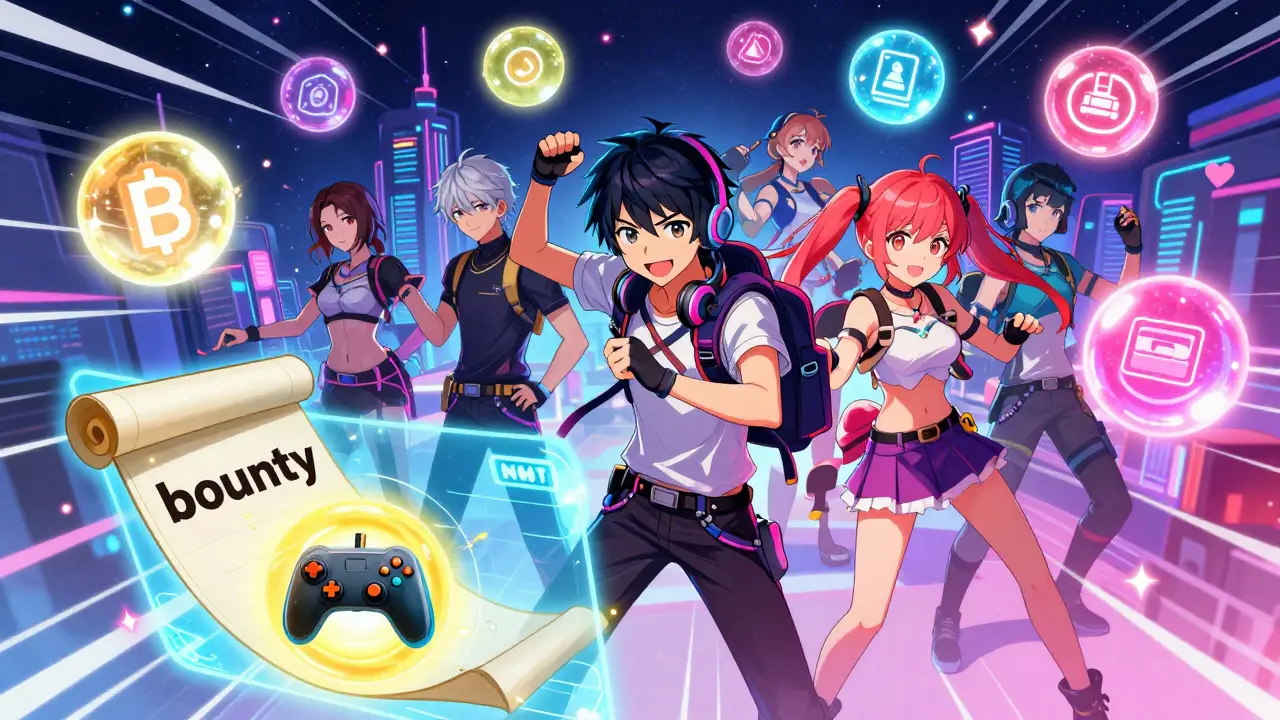
This is where Tegro diverges significantly from standard DEXs. The platform targets the growing Web3 gaming sector with a dedicated marketplace for in-game assets and NFTs. But the most unique component is the bounty system. Imagine you are a skilled player in a game like Axie Infinity who wants to earn extra income by completing specific tasks, such as reaching a certain level or winning a match. You can find "bounty posters" on Tegro who offer payouts for these exact tasks. You act as the "bounty hunter," complete the task, and get paid in crypto.
For developers, Tegro offers "Tegronomics," a framework designed to help create sustainable economic models for games. The user experience here shifts dramatically from the sober trading dashboard to an intergalactic space theme with vibrant neon glows and 3D elements. This dual-aesthetic approach caters to two distinct user bases: serious traders who want efficiency and gamers who want immersion. The bounty system includes wallet integration and a dashboard for managing listings, making it a structured way to monetize gaming skills directly on-chain.
Tegro Money: Payment Infrastructure for Merchants
Beyond trading and gaming, Tegro operates a payment processing arm called Tegro Money. This is aimed at businesses and merchants who want to accept crypto payments. It supports recurring payments, which is useful for subscription-based services, and offers specific tools for industries like transportation (reducing payment time via mobile apps without 3D-Secure) and lending (supporting Card2Account channels for quick loan repayment). For developers integrating these services, API documentation is available with code examples in PHP. This B2B side of the business suggests Tegro is trying to build a complete financial stack, not just a trading venue.

Security, Fees, and Risk Assessment
Here is where you need to be cautious. Because Tegro is a non-custodial platform, you maintain ownership of your assets, which eliminates the risk of exchange insolvency (like FTX). However, this shifts the risk to smart contracts. As of mid-2026, comprehensive public details on smart contract audits are sparse. While the team mentions a bug bounty program on their GitHub, the scope and reward structure aren't widely publicized. Always verify audit reports independently before depositing significant capital.
Fee structures are also not clearly defined in general marketing materials. You will likely encounter maker/taker fees for trading, withdrawal fees for moving assets off-chain, and potential commissions on the gaming marketplace. The TGR token may offer fee discounts, but specific percentages require checking the live platform. Additionally, cross-chain bridges always carry inherent risks. Given the history of bridge exploits in DeFi, ensure you are comfortable with the additional layer of complexity involved in moving assets between TON and BSC.
| Feature | Tegro | Standard AMM DEX (e.g., Uniswap) |
|---|---|---|
| Order Matching | Advanced Orderbook | Automated Market Maker (Pool) |
| Custody | Non-Custodial | Non-Custodial |
| Primary Chains | TON, BSC | Ethereum, Polygon, Arbitrum, etc. |
| Gaming Integration | Native Marketplace & Bounty System | Limited or None |
| Payment Processing | Integrated (Tegro Money) | Usually Separate Service |
| MEV Protection | Claimed Robust Protection | Variable (Often Vulnerable) |
Who Should Use Tegro?
Tegro is best suited for three types of users. First, traders who prefer orderbook mechanics over AMM slippage and are already active on TON or BSC. Second, Web3 gamers and developers who want a unified platform for trading in-game assets and earning through bounties. Third, tech-savvy merchants looking for crypto payment solutions with recurring billing capabilities. It is less suitable for beginners who want a simple, all-in-one app with deep liquidity and extensive customer support, as the learning curve for cross-chain DeFi and gaming integrations can be steep.
Frequently Asked Questions
Is Tegro a centralized or decentralized exchange?
Tegro is a decentralized exchange (DEX). It uses a non-custodial orderbook system, meaning users hold their own assets in wallets during trades. However, it operates as a hybrid ecosystem with integrated gaming and payment services, distinguishing it from pure trading DEXs.
Which blockchains does Tegro support?
The platform primarily focuses on cross-chain capabilities between The Open Network (TON) and Binance Smart Chain (BSC). Assets can be transferred and traded between these two networks within the Tegro ecosystem.
What is the TGR token used for?
The TGR token is the native payment token for the Tegro ecosystem. It is used for paying service fees, purchasing goods via Tegro Money, and potentially for bridging assets. Holding TGR may also influence fee structures or access to certain platform features.
How does the Tegro bounty system work?
The bounty system connects "posters" who pay for specific gaming tasks (like leveling up in a game) with "hunters" who complete them. Hunters earn rewards in crypto upon task completion. It includes a dashboard for listing bounties and wallet integration for seamless payments.
Are there any known security risks with Tegro?
As a DeFi platform, Tegro carries standard smart contract risks. While it claims MEV protection and non-custodial safety, independent audit details are limited. Users should verify current audit status, check bridge security, and start with small amounts to test functionality before committing significant capital.
15 Comments
Write a comment





Kate Staab
August 18, 2026 AT 07:48Oh, look at us all pretending that "hybrid" means anything other than a shiny new way to lose your money. The audacity of this platform is truly staggering. They claim MEV protection but don't even tell you how they achieve it? That is not innovation; that is negligence dressed up in a tuxedo. I have seen enough "revolutionary" DEXs come and go, and every single one of them had the same fatal flaw: lack of transparency. If you cannot audit your own smart contracts without hiding behind vague marketing speak, why should we trust you with our liquidity? It is frankly insulting to the intelligence of anyone who has spent more than five minutes in DeFi. The gaming angle is just a gimmick to distract from the fact that the core trading product is unproven. Do not be fooled by the neon lights.
Dianne Ritter
August 20, 2026 AT 07:36I think it’s interesting that they are trying to bridge TON and BSC specifically. I’ve been watching TON grow because of Telegram integration, so seeing a dedicated cross-chain tool for that ecosystem is actually quite promising. The orderbook model does sound better for large trades than AMMs, provided the liquidity is there. Just need to see if the volume backs up the claims.
Tasha Davis
August 21, 2026 AT 23:05OMG the bounty system sounds SO cool! I play Axie Infinity on the side and having a built-in way to get paid for leveling up or winning matches would be amazing. No more chasing down random Discord servers to find people who want to pay for boosts. This could really change the game for casual gamers who want to earn crypto without becoming full-time pros. I am so excited to try this out!
OLIVER CHRISTIAN
August 22, 2026 AT 16:17Great point about the TON integration. From a technical standpoint, the biggest hurdle here isn't the orderbook logic-it's the liquidity depth. Orderbooks require two-sided markets to function efficiently. If Tegro is primarily a one-way flow from TON to BSC or vice versa, you're going to suffer from wide spreads unless they have significant market maker incentives in place. The mention of "gasless quotes" is a nice UX touch, but remember that execution gas still applies on the underlying chain. For those interested in the infrastructure side, keep an eye on their GitHub activity regarding the bug bounty program. If the rewards are competitive, we might start seeing more independent audits pop up soon. Otherwise, treat the TVL numbers with a healthy dose of skepticism until third-party data aggregators like DefiLlama pick it up reliably.
Kelsey Anne
August 23, 2026 AT 20:00You're missing the obvious. No public audit means no trust. Period. Stop making excuses for bad engineering.
Teri W
August 25, 2026 AT 18:08Drama alert! 🚨 Who else is worried that this whole thing is just a pump-and-dump scheme wrapped in a Web3 gaming skin? The "intergalactic space theme" is doing a LOT of heavy lifting to hide the fact that we don't know where the funds go when you trade. I mean, sure, non-custodial is great, but what happens when the bridge gets exploited? We've seen it happen before, and the recovery process is a nightmare. I'm keeping my distance until they publish a proper whitepaper update with real numbers, not just vibes and neon colors. Let's hope they aren't just burning cash on UI designers instead of security engineers.
Leah Humphrey
August 26, 2026 AT 05:59The slippage mitigation via orderbook matching is theoretically superior to constant product AMMs, but only if the book is deep. Without visible TVL metrics, it's hard to assess the effective price impact for mid-size trades. Also, the MEV protection claim is vague; private mempool routing is standard now, but implementation details matter for latency and cost. Bridging between TON and BSC introduces additional vector surface area for exploits, given the heterogeneity of the execution environments. Fee opacity is a red flag for institutional adoption, as compliance teams require granular breakdowns of maker/taker/bridge costs. Until these data points are standardized and publicly indexed, the risk-adjusted return profile remains suboptimal compared to established L1 DEXs.
Jade Brown
August 28, 2026 AT 00:48Let's be real, this platform is a beautiful disaster waiting to happen. You've got a fancy UI, a token nobody asked for, and a "bounty system" that sounds like a gig economy for gamblers. The jargon soup in their docs is thick enough to choke a horse-"Tegronomics"? Really? Give me a break. The real issue is the bridge. TON to BSC is a risky bet, and if the liquidity dries up, you're stuck holding a bag of digital air. I'd rather stick to Uniswap or PancakeSwap where I know exactly how the math works. This feels like a speculative play for degens who want to feel like they're part of some exclusive club, not for actual traders who care about capital preservation. Watch out for the rug pull, folks. The neon lights are pretty, but the foundation is shaky.
Stephanie Millar
August 30, 2026 AT 00:48Hello everyone! , I just wanted to add a little perspective from the UK side. , The concept of a decentralized orderbook is certainly intriguing, especially as we move away from pure AMM models. , However, as always with new protocols, due diligence is key! , It would be wonderful to see more clarity on the regulatory stance, particularly concerning MiCA in Europe. , A seamless user experience is vital, but security must remain paramount. , Looking forward to seeing how this evolves over the next few quarters! , Keep sharing your insights! , Cheers! ,
Nikki keller
August 31, 2026 AT 04:46There is a philosophical tension here between the desire for decentralization and the practical need for liquidity depth. An orderbook is essentially a social contract among participants; it requires a critical mass of users to function effectively. If Tegro fails to attract enough organic volume, the "superiority" of the orderbook model evaporates, leaving users with higher fees and worse prices than an AMM. This is not just a technical problem, but a network effect challenge. The gaming integration attempts to solve this by creating utility outside of pure speculation, which is a clever pivot. However, sustainability depends on whether the gaming community values the platform enough to stay long-term. It is a delicate balance between being a utility provider and a speculative venue.
miranda gamboa
September 1, 2026 AT 21:09Love the ambition here! The cross-chain capability between TON and BSC is a huge pain point right now, so solving that with a native orderbook is a strong value prop. I'm curious about the developer experience though-are the API docs for Tegro Money robust enough for serious fintech integrations? If they can handle recurring payments securely, that opens up a whole new market beyond just gamers. Excited to see if the bounty system scales beyond niche games. This could be a game-changer for Web3 monetization strategies!
Kiran Jayaram
September 3, 2026 AT 08:38typical western hype cycle nonsense. another scammy dex with zero substance. they talk about mev protection but dont even show the code. indian devs build better tech with less budget. stop wasting time on this toy and look at actual projects. the gaming angle is just fluff to fool retail investors. i have seen too many of these platforms collapse within months. do your own research or stay poor.
Uday N M
September 3, 2026 AT 16:00Interesting use case. The focus on TON is relevant given its growing adoption in specific regions. The orderbook mechanism offers precision that AMMs often lack for larger positions. Regulatory clarity will be the deciding factor for broader acceptance. The payment infrastructure suggests a long-term vision beyond simple token swapping. Needs to prove reliability under load.
Melissa G
September 4, 2026 AT 21:26One often overlooked aspect of such hybrid platforms is the cultural shift required for mainstream adoption. While the technology may be sound, the interface described-a dual aesthetic of sober trading dashboards and vibrant gaming themes-suggests a fragmented user base. This duality could dilute brand identity, making it difficult to appeal simultaneously to high-frequency traders and casual gamers. Furthermore, the reliance on a native token (TGR) for essential functions creates a circular dependency that can inflate perceived value without corresponding utility. As we navigate this evolving landscape, it is crucial to distinguish between genuine innovation and superficial rebranding of existing concepts. The success of Tegro will ultimately depend on its ability to unify these disparate elements into a cohesive, user-centric ecosystem that delivers tangible value across all segments.
Patrick Pat
September 5, 2026 AT 04:45Sarcastic take: Oh wow, another "revolutionary" DEX that promises the moon while hiding its books. The "MEV protection" claim is doing a lot of work for a team that hasn't published a single solid audit report. I guess the neon glow is supposed to make up for the lack of transparency. If you're brave enough to trust your life savings to a platform that treats security disclosures like an optional extra, more power to you. Just don't say I didn't warn you when the bridge exploits hit. The gaming bounty system is cute, but let's not confuse a fun feature with a solid business model. Keep your expectations low and your wallets locked.