Locked vs Flexible Staking Options: Which One Fits Your Crypto Strategy?

Staking Rewards Calculator
Calculate Your Staking Rewards
Expected Results
When you stake cryptocurrency, you’re not just earning interest-you’re helping secure the network. But here’s the catch: not all staking is the same. Two main options dominate the scene: locked staking and flexible staking. One locks your coins for weeks or months to give you higher rewards. The other lets you pull your money out anytime, but pays less. Which one should you pick? It depends on how you think about money, risk, and timing.
What Locked Staking Really Means
Locked staking is like putting your crypto in a savings account with a fixed term. You agree to leave your tokens on the network for a set period-usually 15, 30, or 90 days-sometimes even longer. During that time, you can’t move them. If you try to withdraw early, you lose all the rewards you’ve earned so far. No partial refunds. No exceptions.This system exists for a reason: it makes the blockchain more secure. When validators (the people who verify transactions) know their coins are locked for months, they have a strong incentive to act honestly. If they try to cheat, they risk losing everything. That’s why networks like Ethereum and Polygon reward locked staking with higher yields.
On Binance, for example, locked staking for assets like MATIC or ATOM can pay between 10% and 30% annual percentage yield (APY), depending on the lock period. The longer you commit, the higher the return. A 90-day lock might earn you 25%, while a 15-day lock might only give you 12%. Rewards are usually distributed daily, but they’re only yours if you stick to the contract.
Think of it like a bond. You give up liquidity for a better return. It works great if you’re holding crypto long-term and don’t plan to trade anytime soon. But if the market suddenly drops 30% and you need cash? Tough luck-you’re stuck until the lock ends.
Flexible Staking: Freedom With a Trade-Off
Flexible staking flips the script. You can stake your tokens today and unstake them tomorrow. No penalties. No waiting. Your coins stay under your control at all times. That’s why it’s popular with traders, DeFi users, and anyone who doesn’t want to be tied down.Platforms like Binance Flexible Savings and Kraken’s flexible staking offer this option. You still earn rewards-just not as much. Binance’s flexible rates are often half of what locked staking pays. For example, while locked ETH might earn 5.8% APY, flexible ETH might only give you 2.5%. Kraken’s flexible staking for ADA or DOT follows the same pattern: lower returns, zero restrictions.
The big advantage? Liquidity. If Solana spikes 40% overnight, you can unstake your SOL, sell it, and jump on the trend. If you need to pay for an unexpected bill, you don’t have to wait 30 days. This flexibility is priceless for active participants in the crypto market.
But here’s the downside: networks rely on stable validator participation. If everyone can leave at any moment, it’s easier for bad actors to exploit short-term dips or launch attacks. That’s why flexible staking usually comes with lower APY-it’s the price you pay for convenience.
Why Locked Staking Pays More (And Why That Matters)
You might wonder: why do locked staking rewards beat flexible ones so badly? It’s not just greed. It’s math and risk.Blockchains need predictable, long-term capital to stay secure. Locked staking guarantees that. Validators can’t suddenly pull out when the price dips or when a competitor offers better rates. That stability lets networks run smoother, process transactions faster, and reduce the chance of attacks.
Because locked staking reduces network risk, the protocol can afford to reward participants more. Think of it like insurance: the longer you commit, the less risky you are to the system, so you get paid more.
Platforms like Crypto.com reinforce this with tiered rewards. The more CRO you lock for a year, the higher your APY. It’s not just about holding-it’s about loyalty. If you’re the type who holds crypto for years anyway, locked staking turns your idle assets into a high-yield income stream.
Flexible staking doesn’t offer that same level of commitment. Validators can come and go. That uncertainty means the network can’t afford to pay as much. It’s a trade-off: control vs. cash.

What About Liquid Staking? A Third Option
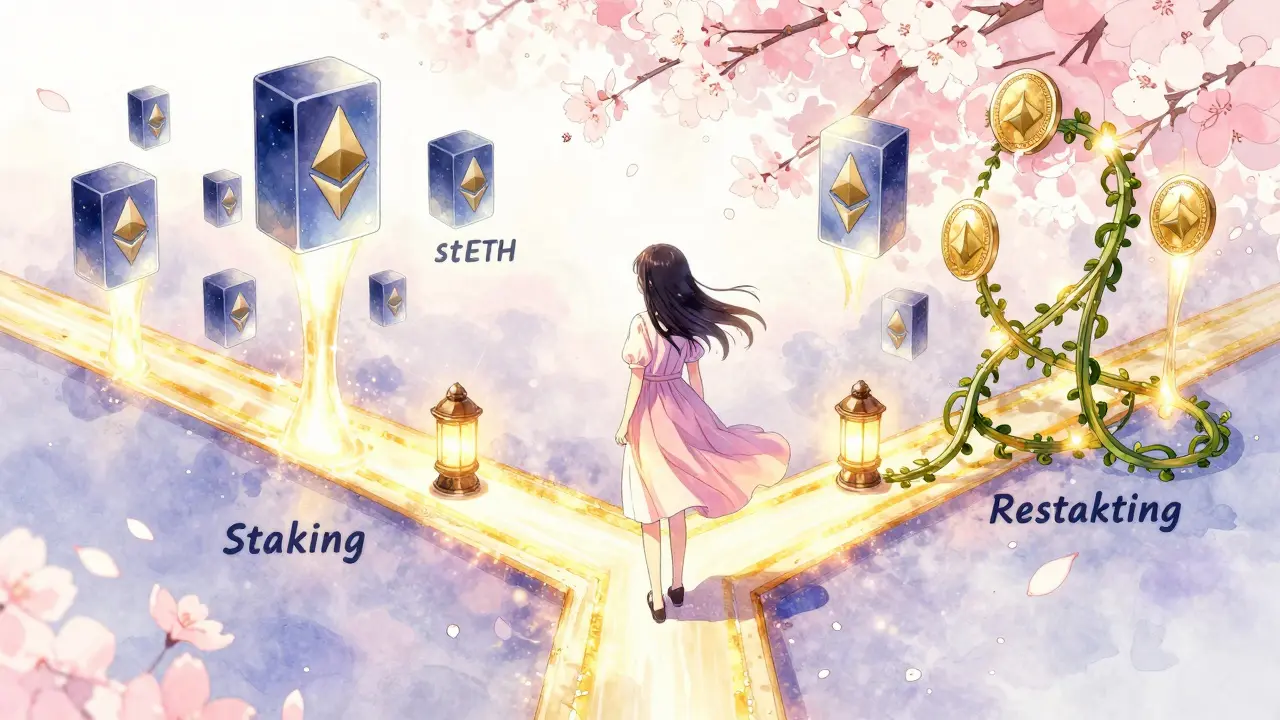
There’s a third way that’s gaining traction: liquid staking. Projects like Lido DAO let you stake your ETH, SOL, or POL and get a token in return-like stETH or stSOL-that represents your staked assets and rewards. You can trade, lend, or use these tokens in DeFi protocols while your original coins are still earning staking rewards.This solves the biggest problem with locked staking: losing access to your assets. With liquid staking, you get the high APY of locked staking and the flexibility of flexible staking. You’re not stuck-you’re just using a derivative token instead of the original.
But it’s not perfect. Liquid staking introduces new risks. What if the protocol gets hacked? What if the peg between your stETH and ETH breaks? These are real concerns, and they’re not covered by traditional insurance. Still, for advanced users comfortable with DeFi, liquid staking is becoming a go-to strategy.
Who Should Choose Locked Staking?
Locked staking is ideal for:- Long-term holders who don’t plan to sell soon
- People who want to automate passive income without active trading
- Those who want to avoid emotional decisions during market crashes
- Investors who prioritize higher returns over immediate access
If you bought Bitcoin or Ethereum a year ago and plan to hold for five more, locked staking makes sense. You’re not using those coins for trading-you’re just letting them work for you. The higher APY adds up fast. Over a year, a 25% return on 10 ETH could mean 2.5 extra ETH. That’s not pocket change.
Who Should Choose Flexible Staking?
Flexible staking fits people who:- Trade crypto regularly
- Use DeFi platforms and need quick access to funds
- Want to react to market movements without waiting
- Prefer full control over their assets
If you’re using tools like Cryptohopper or TradingView to automate trades, flexible staking lets you keep your capital fluid. You can stake your USDC, wait for a signal, unstake, buy a dip, and re-stake-all in minutes. You’re not sacrificing control for a few extra percentage points.

Hybrid Strategies Work Best for Most People
You don’t have to pick one. Many experienced users split their holdings. For example:- 60% in locked staking for long-term growth
- 30% in flexible staking for trading flexibility
- 10% in liquid staking for DeFi exposure
This way, you get the best of both worlds: steady high returns from locked staking, quick access from flexible, and DeFi integration from liquid. It’s not about choosing the "best" option-it’s about matching your behavior to your goals.
Security Risks: What No One Tells You
Most guides focus on APY. But security matters too.Locked staking strengthens the network. Validators are locked in. They have skin in the game. That makes attacks harder and more expensive.
Flexible staking weakens that bond. If a major network like Polygon suddenly drops 20%, and everyone unstakes at once, it could destabilize validation. That’s why some networks limit flexible staking or cap the total amount allowed.
And don’t forget platform risk. If Binance or Kraken gets hacked, your locked or flexible staked coins are still at risk. Always use reputable platforms. Never stake on unknown exchanges.
What’s Next for Staking?
The future of staking is blending options. Liquid staking is growing fast. Ethereum’s upgrade to PoS already changed how people think about locking assets. Soon, you might see:- Dynamic APY that adjusts based on network demand
- Partial unlocking-withdraw 50% of your stake early with a small penalty
- Staking-as-a-service for non-tech users
Right now, the choice is simple: locked for yield, flexible for freedom. But the lines are blurring. The best staking strategy tomorrow might not look like either option today.
Can I lose my crypto in locked staking?
You won’t lose your original crypto unless the platform gets hacked or goes bankrupt. But if you withdraw early from locked staking, you’ll lose all the rewards you earned. Your principal stays safe-just not your earnings.
Is flexible staking safe?
Yes, as long as you use trusted platforms like Binance, Kraken, or Coinbase. The safety of your coins depends on the exchange’s security, not the staking type. Flexible staking doesn’t increase your risk of theft-it just means you can move funds faster.
Which gives better returns: locked or flexible staking?
Locked staking almost always pays more. On Binance, locked staking can offer 2-3 times the APY of flexible staking. For example, 25% APY vs. 8% APY on the same coin. But you give up liquidity. Flexible staking is better for short-term flexibility, not maximum profit.
Can I stake the same coin in both locked and flexible options?
Yes, and many users do. You can lock half your ETH for higher rewards and keep the other half flexible for trading. Most platforms allow you to split your holdings across multiple staking products at the same time.
What happens if the price of my staked coin drops?
You still earn staking rewards in the same coin. If ETH drops from $3,000 to $2,000, you still get your 5% APY in ETH-but your USD value falls. That’s market risk, not staking risk. The rewards are fixed in token amount, not dollar value.
Do I need to manage validators myself?
No. On exchanges like Binance or Kraken, they handle everything. You just stake, earn, and withdraw. You only need to manage validators if you’re running your own node on Ethereum or Solana-which most people don’t do.
Deciding between locked and flexible staking isn’t about finding the perfect option. It’s about matching your behavior to your goals. Are you a passive holder? Lock it. Are you a trader? Keep it flexible. Most people do both. The key is knowing why you’re choosing each one-and not letting FOMO or fear drive your decision.

19 Comments
Write a comment





Kenneth Ljungström
December 8, 2025 AT 15:13Sandra Lee Beagan
December 9, 2025 AT 09:28michael cuevas
December 10, 2025 AT 02:02Nina Meretoile
December 10, 2025 AT 07:25Barb Pooley
December 10, 2025 AT 22:42Isha Kaur
December 12, 2025 AT 21:59Glenn Jones
December 14, 2025 AT 20:07Chris Mitchell
December 16, 2025 AT 00:41Regina Jestrow
December 16, 2025 AT 21:49Martin Hansen
December 18, 2025 AT 14:40Lore Vanvliet
December 19, 2025 AT 19:10Scott Sơn
December 21, 2025 AT 12:51Stanley Wong
December 22, 2025 AT 04:30Nicole Parker
December 23, 2025 AT 17:49Brooke Schmalbach
December 25, 2025 AT 04:45Shane Budge
December 25, 2025 AT 16:56sonia sifflet
December 25, 2025 AT 16:58Chris Jenny
December 26, 2025 AT 10:18Adam Bosworth
December 27, 2025 AT 19:40