Crypto ATMs and the $246 Million Scam Epidemic: How These Machines Are Being Weaponized

Imagine putting cash into a machine that turns it into Bitcoin - quick, easy, no bank account needed. Sounds like a dream, right? Now imagine waking up two hours later to find your life savings gone, with no way to get it back. That’s not a horror movie. That’s what happened to over 10,956 people in 2024. And they lost $246.7 million - all through crypto ATMs.
How Crypto ATMs Work (And Why They’re So Dangerous)
Crypto ATMs look like regular bank ATMs. You insert cash. You scan a QR code linked to your digital wallet. A few minutes later, Bitcoin or another cryptocurrency shows up in your app. Simple. Convenient. And that’s exactly why scammers love them. Unlike traditional ATMs, crypto machines don’t ask for ID unless they’re in states with new laws. No signature. No PIN verification. No fraud alerts. Once you send crypto out of your wallet, it’s gone forever. There’s no chargeback. No customer service line. No bank to call. Criminals know this. They’re not hacking systems - they’re hacking people.The Scam Playbook: How You Get Tricked
Most victims aren’t tech-savvy. They’re seniors, retirees, people trying to help a family member in trouble. Here’s how the scams usually go:- You get a call: "Your grandchild is in jail. Pay $5,000 in Bitcoin right now or they’ll be arrested."
- You go to the nearest crypto ATM. The operator doesn’t ask questions. You insert cash. You scan the QR code they texted you.
- Within minutes, your money is in a wallet controlled by a criminal in another country.
- You call your "grandchild" - they’re fine. The call was fake.
Why the System Isn’t Stopping This
Traditional banks have layers of protection: fraud detection, transaction limits, identity checks, and federal oversight. Crypto ATMs? Not even close. The U.S. Treasury’s FinCEN says many operators aren’t even registered as money services businesses - meaning they don’t have to report suspicious activity. No KYC. No monitoring. No accountability. In states like Arizona, which has around 600 crypto ATMs, operators were allowed to operate with zero rules - until recently. Even when rules exist, enforcement is weak. A machine might display a warning screen saying "Crypto transactions are irreversible," but most people just click "Next" to get their Bitcoin. They’re not reading. They’re scared. They’re rushed. And the machine doesn’t care.Technical Backdoors: When the Machine Itself Is Hacked
It’s not just social engineering. Some crypto ATMs are broken from the inside. Security researchers found critical flaws in the Lamassu Douro model - one of the most common machines used in the U.S. One vulnerability, CVE-2024-0674, lets a hacker with physical access turn the machine into a remote-controlled tool for stealing money. All they need is a USB stick and a few minutes. They can install malware that redirects transactions, steals wallet keys, or even wipes the machine’s logs. These aren’t theoretical risks. Law enforcement has found evidence of organized crime groups using modified ATMs to launder cash into crypto. And since these machines are often placed in convenience stores, gas stations, and strip malls, they’re easy to tamper with.
Arizona’s Bold Move - And Why It’s Not Enough
Arizona became the first state to crack down hard. In 2025, new rules went into effect:- New customers can only send $2,000 per day.
- Existing customers are capped at $10,500.
- Every transaction must show a warning screen that users must click through.
- Operators must refund new customers who report fraud within 30 days - including fees.
Who’s Really Losing? The Numbers Don’t Lie
In Arizona alone, victims lost $177 million in 2024. Scottsdale police recorded $5 million in losses just from crypto ATM scams in the first half of the year. In Peoria, one neighborhood lost nearly $1 million in a single year. These aren’t just numbers. These are people who lost their retirement funds. Their emergency savings. Their homes. One woman in Phoenix lost $89,000 after a scammer pretended to be her grandson’s lawyer. She had to move in with her daughter. She hasn’t left the house since. The FBI says crypto ATM fraud complaints rose 99% in 2024 compared to the year before. That’s not growth. That’s an explosion.Why Crypto Makes This Worse Than Other Scams
Credit card fraud? You can dispute it. Bank transfers? They can be reversed. PayPal? There’s buyer protection. Crypto? No. Zero. Nada. Blockchain is designed to be irreversible. That’s a feature - not a bug. But when criminals use it to steal from ordinary people, that feature becomes a weapon. There’s no central authority to call. No regulator to appeal to. The blockchain doesn’t care who you are. It just moves the money.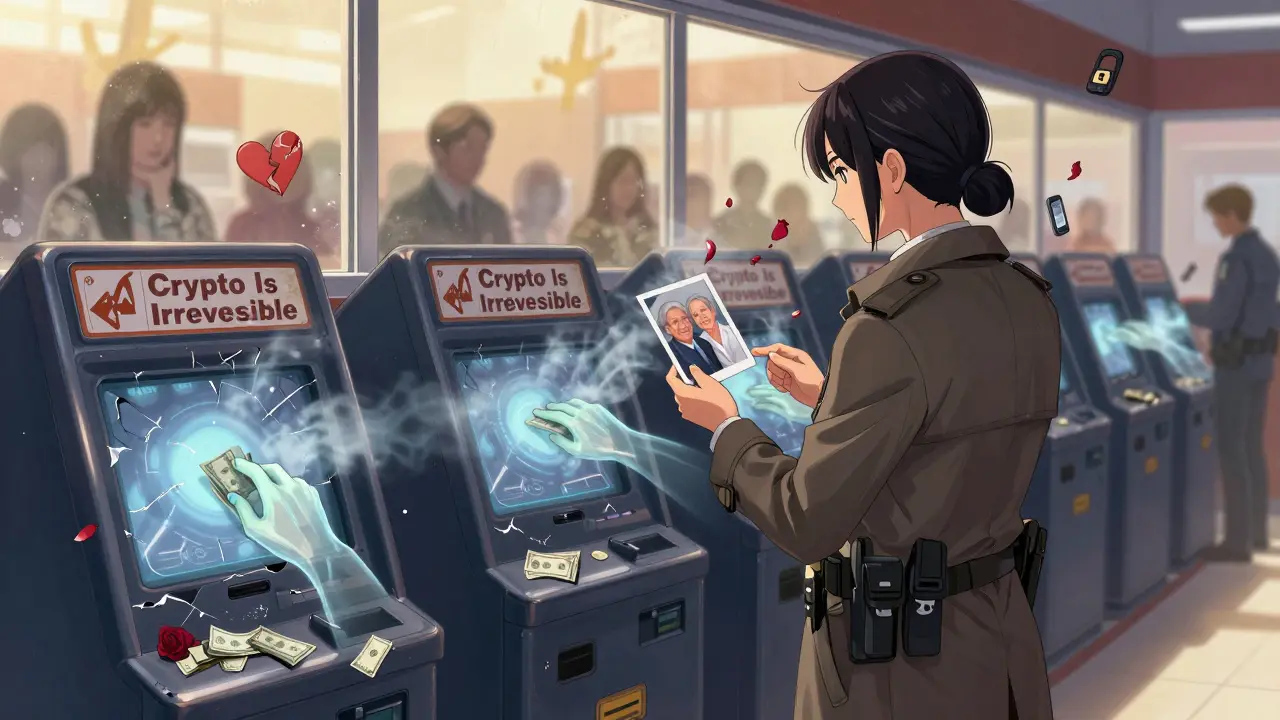
What You Can Do - Before It’s Too Late
If you or someone you love is considering using a crypto ATM, here’s what you need to know:- Never use a crypto ATM for urgent payments. If someone tells you to send crypto immediately - it’s a scam.
- Never scan a QR code from a stranger. Even if it’s "your grandchild’s friend" - it’s not.
- Check if the operator is registered. In Arizona, operators must be licensed. Ask for their license number. Look it up online.
- Use a hardware wallet. If you’re buying crypto, send it to a wallet you control - not one provided by the ATM operator.
- Teach older adults. Sit with them. Show them how these scams work. Don’t assume they know.
The Bigger Picture: Regulation Is Lagging Behind the Crime
In 2025, at least 40 states introduced crypto-related bills. Eleven passed new rules targeting ATMs. But federal oversight? Still patchy. FinCEN issued a warning in August 2025 - but warnings don’t shut down machines. The industry claims crypto ATMs promote financial freedom. That’s true - for criminals. For the average person? They’re a trap wrapped in convenience. Until every machine requires ID, limits transactions, logs every user, and reports suspicious activity - this epidemic won’t end. And until people understand that crypto isn’t magic money - it’s digital cash with no safety net - the losses will keep climbing.What Comes Next?
Some companies are trying to fix this. Newer ATMs now require facial recognition. Others use voice verification. A few even delay transactions for 24 hours. But these features are rare - and expensive. Most operators won’t pay for them. The truth? Crypto ATMs were never meant to be safe. They were meant to be fast. And in a world where speed matters more than security, the criminals always win. If you’re thinking of using one - pause. Ask yourself: Why does this need to happen right now? And who really benefits? The answer might save you more than money.Are crypto ATMs legal?
Yes, in most places - but that doesn’t mean they’re safe. Many operators operate without proper licenses or fail to follow anti-fraud rules. Federal law requires them to register as money services businesses, but enforcement is weak. In states like Arizona, new laws now require licensing and customer limits - but most states still have no rules at all.
Can you get your money back if you’re scammed through a crypto ATM?
Almost never. Crypto transactions are irreversible by design. The only exception is under Arizona’s new law, where new customers can get a full refund - including fees - if they report fraud within 30 days. But this only applies if you’re a first-time user and you report it quickly. In most cases, once the crypto leaves the machine, it’s gone for good.
Why are seniors targeted so often?
Scammers target seniors because they’re often trusting, less familiar with digital currency, and may have significant savings. The FBI reports that over two-thirds of crypto ATM victims in 2024 were over 60. Scammers use emotional pressure - fake emergencies, sick relatives, legal threats - to create urgency. Seniors are more likely to act without verifying, especially when they’re scared.
Do crypto ATMs require ID?
It depends on the state and the machine. In most places, no ID is required for small transactions. In Arizona, new customers must verify identity for transactions over $2,000. But many operators ignore this rule. Some machines have cameras and ID scanners - but they’re often turned off or broken. Never assume you’re protected.
How can I report a crypto ATM scam?
Report it immediately to the FBI’s Internet Crime Complaint Center (IC3) at ic3.gov. Also file a report with your local police and FinCEN. Include details: where the ATM was located, the time of the transaction, any phone numbers or messages you received, and screenshots if possible. Even if you can’t get your money back, your report helps law enforcement track patterns and shut down criminal networks.


14 Comments
Write a comment





Mandy McDonald Hodge
December 28, 2025 AT 12:14my grandma just got scammed last month 😭 she thought her grandson was in jail and spent $12k at a crypto ATM in the gas station down the road. i didn’t even know she had a wallet. we’re lucky she didn’t lose her house. please, if you know someone old - sit with them. show them these scams. it’s not their fault. they’re just scared.
Adam Hull
December 28, 2025 AT 12:23The entire premise is a fallacy wrapped in performative outrage. Crypto ATMs are not the problem - centralized banking is. You want to blame machines? Fine. But let’s not pretend that Wells Fargo doesn’t siphon billions from retirees via overdraft fees and predatory loans. At least with crypto, there’s no middleman skimming 3% off the top.
Also, ‘irreversible’ is a feature, not a bug. If you can’t handle that, don’t touch it. Stop infantilizing adults who choose risk.
Elisabeth Rigo Andrews
December 28, 2025 AT 23:10Let’s be real - this isn’t about crypto ATMs. It’s about the complete collapse of intergenerational trust and financial literacy. The fact that 70% of victims are over 60 isn’t a flaw in the tech - it’s a failure of the social contract. We’ve outsourced elder care to algorithms and corporate apps while abandoning human connection. The machine doesn’t care if you’re scared. Neither does your nephew who won’t return your calls.
And don’t get me started on the ‘refund’ loophole in Arizona. That’s a PR stunt. Scammers just cycle through 5 different ATMs. Or worse - they get a fake ID and become ‘existing customers.’ The system is rigged to let them win.
Also, why are we still calling these ‘ATMs’? They’re not automated tellers. They’re digital cash registers with zero oversight. Rename them. Call them ‘Trust Crushers.’ At least then people might pause before inserting their Social Security check.
And the Lamassu flaw? CVE-2024-0674? That’s not a vulnerability. That’s a corporate negligence trophy. These machines are sold to convenience stores with no tech support. No patching. No monitoring. Just a screen that says ‘transactions are irreversible’ like it’s a disclaimer at a carnival ride.
We’re not fighting scammers. We’re fighting apathy. And apathy is the only thing that scales faster than blockchain.
Jordan Fowles
December 30, 2025 AT 08:54It’s not that people don’t understand crypto. It’s that they understand human nature better than they understand code. A voice on the phone saying ‘your grandchild is dying’ bypasses logic. No amount of warning screens can compete with that. The real failure isn’t the ATM - it’s that we’ve built a society where loneliness is so common, people believe strangers over their own family.
Maybe we need more than regulations. Maybe we need more neighbors. More calls. More dinners.
Willis Shane
December 31, 2025 AT 02:00These so-called ‘financial freedom’ tools are nothing but digital quicksand. The industry preaches decentralization while operating in the shadows of unregulated storefronts in strip malls. This isn’t innovation - it’s exploitation dressed in blockchain buzzwords. The fact that FinCEN has issued ‘warnings’ instead of shutting down unlicensed operators proves regulatory capture is alive and well. This isn’t capitalism. It’s criminal libertarianism.
Emily L
December 31, 2025 AT 08:18why do people still use these things?? like seriously. if someone calls you and says your kid is in jail, you call the kid. not a machine. duh. also why are you scanning qr codes from strangers? that’s like handing your house keys to a guy in a hoodie. i don’t get it.
Jake West
January 1, 2026 AT 17:47Wow. Another ‘poor grandma’ sob story. Can we stop pretending this is about victims? It’s about people who made dumb decisions. You don’t get to blame the machine because you fell for a 1990s phone scam with Bitcoin. If you’re that gullible, maybe you shouldn’t be allowed to use ATMs at all. Or phones. Or the internet. Just live in a cave.
Also, Arizona’s law? Pathetic. You think a $2k limit stops a scammer? They just tell the victim to go to 3 different machines. Or use a fake ID. Or pay in cash to a guy at a gas station. This whole article is performative outrage. The real problem? People who think tech is magic.
Shawn Roberts
January 3, 2026 AT 14:37yo i just saw this and had to say - if you’re thinking about using a crypto atm, just stop. breathe. call someone. i used one last year to buy some btc for my sister’s birthday and honestly? i felt weird the whole time. like i was handing over cash to a ghost. then i learned about the scams. i deleted my wallet. no regrets. we gotta protect each other. 🙏
prashant choudhari
January 5, 2026 AT 11:34India has no crypto ATMs. But we have a different problem - people sending crypto to fake ‘investment gurus’ on WhatsApp. Same outcome. Same tragedy. The machine is just a tool. The real issue is the lack of financial education. Teach people how to verify, how to question, how to pause. Not just ban machines.
Bruce Morrison
January 5, 2026 AT 14:34My dad used one last year. Thought he was helping a friend. Lost $7k. He’s fine now. But he doesn’t talk about it. I don’t blame him. Shame is real. What we need isn’t more laws. It’s more conversations. Sit down. Ask. Listen. Don’t assume they know. Don’t assume they’re dumb. Just be there.
Steve Williams
January 6, 2026 AT 18:33As someone from Nigeria, I’ve seen how digital finance can be both a lifeline and a trap. In places with weak banking infrastructure, crypto ATMs offer access. But without identity verification, they become weapons. The solution isn’t to ban them - it’s to build systems that are both accessible and secure. This is a global issue. We need international standards, not state-by-state patchwork.
dina amanda
January 8, 2026 AT 04:13this is all a government psyop. crypto is the people’s money. the banks and the fed are scared. they don’t want you to have control. the ‘scams’? they’re just stories to scare you away. real people lose money in banks every day. no one cares. but crypto? oh no, it’s dangerous. it’s all a distraction. the real scam is the dollar.
Abhisekh Chakraborty
January 8, 2026 AT 14:36you people are so naive. why do you think these machines exist? they’re not for you. they’re for the elite. the ones who want to move money without paper trails. the real victims? the ones who get caught in the crossfire. but don’t worry - your grandma’s $12k? it’s just a drop in the ocean. the real money is moving through offshore wallets and shell companies. you’re just collateral damage.
Andrew Prince
January 8, 2026 AT 16:47It is both intellectually and ethically indefensible to attribute the precipitous rise in financial victimization among elderly demographics to the mere existence of cryptocurrency automated teller machines. One must contextualize this phenomenon within the broader sociopolitical paradigm of neoliberal deregulation, wherein the erosion of institutional safeguards - particularly in the domains of financial oversight and intergenerational social cohesion - has created an epistemic vacuum wherein vulnerable populations are rendered susceptible to predatory social engineering tactics. The machine is not the agent; it is the conduit. The true culpability lies in the systemic abandonment of civic responsibility, the commodification of human vulnerability, and the failure of public institutions to enforce even the most rudimentary fiduciary obligations upon private actors operating within the financial ecosystem. Furthermore, the proposed regulatory interventions - such as Arizona’s daily transactional caps - constitute a form of performative governance, wherein superficial policy adjustments are deployed to assuage public anxiety without addressing the ontological underpinnings of the crisis. Until the legal architecture of digital asset intermediation is reconstituted to enforce mandatory identity verification, real-time transactional monitoring, and mandatory cooling-off periods, any attempt to mitigate this epidemic will remain an exercise in rhetorical theater.